

In This Article
Somewhere around mile 47 of your first 50-miler, your feet stop being feet and start being a referendum on every gear decision you’ve ever made. That’s not drama — it’s biomechanics. Your arches flatten, your feet swell, your socks turn into sandpaper, and the shoe that felt like a cloud at the start line can feel like a medieval torture device by the time the sun comes back up. Choosing the right running shoes for women ultra marathon racing isn’t a minor logistics detail. It’s arguably the single gear decision most likely to end — or save — your race.

What Are Running Shoes for Women’s Ultra Marathon?
Running shoes for women ultra marathon events are trail or hybrid shoes built with higher stack heights, wider platforms, and roomier toe boxes than standard road trainers, designed specifically to absorb repetitive impact and accommodate foot swelling across distances beyond 26.2 miles. By definition, any race longer than the standard 26.2-mile marathon distance qualifies as an ultramarathon, and the shoe demands change dramatically once you cross that line — you can read more about ultramarathon distances and history on Wikipedia.
Here’s the thing nobody tells you at the running store: the shoe that’s “best” has almost nothing to do with brand loyalty and everything to do with how your particular feet behave under 12+ hours of repetitive load. Some runners’ feet balloon half a size by mile 60. Others barely change at all but develop hot spots on the outside of the pinky toe like clockwork. Below, we’ve dug into seven real, currently available women’s ultra shoes — spanning budget workhorses to $250 superfoam rockets — and broken down exactly who each one is built for, based on real specs, real aggregated reviewer sentiment, and honest trade-off analysis. No fluff, no manufactured hands-on stories — just the research you’d want if you were staring down a start line in a few months.
Quick Comparison Table
| Shoe | Best For | Stack Height (Heel/Forefoot) | Drop | Price Range |
|---|---|---|---|---|
| Brooks Cascadia 19 | Budget-conscious first-timers | 35mm / 29mm | 6mm | $140–$160 |
| Topo Athletic MTN Racer 4 | Wide or swelling feet | 33mm / 28mm | 5mm | $145–$165 |
| La Sportiva Akasha II | Technical, rocky descents | 31mm / 25mm | 6mm | $150–$175 |
| Hoka Speedgoat 7 | All-around versatility | 37mm / 32mm | 5mm | $160–$175 |
| Altra Olympus 6 | Zero-drop, foot-shape fans | 33mm / 33mm | 0mm | $175–$190 |
| Salomon S/Lab Ultra Glide 1.5 | Plushest possible ride | 40mm / 32mm | 6mm | $240–$260 |
| Hoka Mafate X | Max protection, 100-mile days | 49mm / 41mm | 8mm | $220–$230 |
Looking at the spread above, there’s a pretty clean line between “protection-first” shoes and “efficiency-first” shoes, and almost nothing here is a bad choice on paper — the differences show up in how each shoe feels by hour eight. The Brooks Cascadia 19 and Topo Athletic MTN Racer 4 anchor the value end without sacrificing much real cushioning, while the Hoka Mafate X and Salomon S/Lab Ultra Glide 1.5 sit at the premium end where you’re paying for exotic foam and carbon tech, not just marketing. If you’re newer to trail ultras, resist the urge to jump straight to the priciest option — fit and toe-box shape matter more than stack height once you’re past 50K.
💬 Bookmark this table now — you’ll want to compare these again after reading the breakdowns below.
Top 7 Running Shoes for Women’s Ultra Marathon: Expert Analysis
We picked these seven specifically to span the budget-to-premium spectrum, cover both zero-drop and traditional-drop philosophies, and represent the terrain variety most ultras throw at you — from smooth fire roads to ankle-twisting singletrack. Every shoe listed is a real, currently sold model; check current price and availability before you buy, since trail shoe pricing shifts with seasonal releases.
1. Brooks Cascadia 19 — toughest budget workhorse for technical terrain
The Cascadia has been the reliable, unglamorous older sibling of the ultra world for over a decade, and version 19 finally trims real weight off a shoe that used to feel like a small dumbbell. Underfoot, the nitrogen-infused DNA Loft v3 midsole and a flexible TrailAdapt rock shield combine for a 35mm heel / 29mm forefoot stack — moderate by 2026 standards, but that’s actually the point. What that moderate stack means in practice is a shoe that stays connected to technical ground instead of floating over it, which matters enormously on root-choked singletrack where ankle stability trumps plushness. Based on the spec comparison against its max-cushion competitors, this is the shoe for runners who trust their feet to do some of the work rather than outsourcing everything to foam. Reviewers consistently note the wide, stable platform and the gusseted tongue that blocks trail debris, though a recurring theme in aggregated feedback is that arch support runs thinner than some runners expect from a “supportive” trail shoe.
Pros:
- ✅ Sticky, durable TrailTack Green outsole handles wet rock confidently
- ✅ Notably lighter than previous Cascadia generations
- ✅ Roomy, accommodating fit works well as feet swell late-race
Cons:
- ❌ Less arch support than some runners prefer
- ❌ Moderate cushioning means more ground feel on very long days
The Brooks Cascadia 19 typically runs in the $140–$160 range, and for that price it’s genuinely hard to beat as a first-ultra shoe or a durable training workhorse — the value verdict here is straightforward: buy this if you want one dependable shoe that won’t blow your budget or your first 50K.
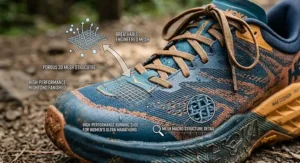
2. Topo Athletic MTN Racer 4 — roomiest toe box for swelling feet
Topo built its entire identity around anatomically shaped, wide toe boxes, and the MTN Racer 4 leans hard into that philosophy while still delivering genuine cushion. The 33mm/28mm stack sits on a ZipFoam midsole that Topo redesigned to be lighter and springier than earlier versions, paired with a 5mm drop that splits the difference between the ground-feel of zero-drop shoes and the cushioned landing of higher-drop models. What most buyers overlook about toe-box width is that it’s arguably more important for ultra comfort than stack height — when your feet swell two hours into a 50-mile effort, a narrow toe box turns into a pressure cooker regardless of how soft the midsole is. This shoe was reportedly the most-worn brand among Appalachian Trail thru-hikers in a recent gear survey, which says something about how it performs across genuinely long mileage. Aggregated reviewer sentiment consistently praises the Vibram Megagrip traction and the accommodating fit, while some reviewers note the ankle collar runs a touch snug compared to the roomy forefoot.
Pros:
- ✅ Wide, foot-shaped toe box reduces pressure as feet swell
- ✅ FKT insole drains water fast after creek crossings
- ✅ Responsive ZipFoam feels lighter than its stack suggests
Cons:
- ❌ Ankle collar fit can feel inconsistent with the roomy forefoot
- ❌ No rock plate, so sharp gravel is more noticeable
Priced around $145–$165, the Topo Athletic MTN Racer 4 earns its spot as the pick for anyone whose feet balloon late in a race — the value math favors it heavily if toe-box room is your top priority.
3. La Sportiva Akasha II — most stable on technical descents
La Sportiva built its reputation in the mountains, not on manicured greenways, and the Akasha II wears that heritage openly. A 31mm/25mm stack with a 6mm drop sits on a dual-injection MEMlex EVA midsole reinforced with internal TPU stabilizers — a detail that matters more than it sounds like on paper. What that stabilizer setup means in real-world terms is a midsole that resists the sideways roll that causes rolled ankles on off-camber, rocky descents, at the cost of feeling firmer and less “marshmallow soft” than shoes like the Speedgoat or Mafate X. Here’s what the spec sheet won’t tell you, but reviewers note repeatedly: this is not a plush recovery shoe, and it’s not trying to be. It’s a stable mountain tool. Aggregated feedback frequently highlights confident grip from the dual-compound FriXion outsole, while a common thread in reviews flags the narrower toe box as a poor match for wide or swelling feet.
Pros:
- ✅ Internal TPU stabilizers resist ankle roll on technical ground
- ✅ FriXion XT 2.0 outsole grips confidently on wet rock
- ✅ Thick midsole protects feet from sharp rocks without a rock plate
Cons:
- ❌ Narrower fit than Topo or Altra, tough on wide feet
- ❌ Firmer ride offers less plush comfort over ultra distances
Priced in the $150–$175 range depending on colorway and retailer, the La Sportiva Akasha II is the pick for runners tackling mountainous, technical courses where stability outweighs pillow-soft cushioning.
4. Hoka Speedgoat 7 — lightest max-cushion all-rounder
The Speedgoat name carries serious weight in ultrarunning circles, and version 7 earns it back after a couple of generations that drifted from the formula. The women’s model comes in around 7.9–8.4 ounces per shoe — genuinely light for a shoe with a 37mm/32mm stack — thanks to a switch to supercritical EVA foam, sometimes called SCF, which is nitrogen-infused during the molding process to create tiny air pockets. Based on the spec comparison, what that foam tech means practically is a midsole that absorbs impact like a traditional max-cushion shoe while returning noticeably more energy underfoot than older Speedgoat versions, so it doesn’t feel as dead by mile 40. The 5mm drop keeps things middle-of-the-road rather than committing hard to either zero-drop or high-drop camps. Reviewers consistently describe the redesigned upper as more secure and durable than prior versions, though a recurring theme is that the shoe runs slightly short and narrow through the midfoot, prompting many aggregated reviews to recommend sizing up half a size.
Pros:
- ✅ Excellent weight-to-cushion ratio for daily miles and race day
- ✅ Vibram Megagrip with 5mm lugs handles mixed terrain confidently
- ✅ Redesigned upper improves lockdown versus earlier Speedgoats
Cons:
- ❌ Runs slightly short — sizing up half a size is common advice
- ❌ Narrower midfoot may not suit wide or swelling feet as well
At around $160–$175, the Hoka Speedgoat 7 remains the default “if you only buy one” recommendation in the ultra community, and the value verdict backs that up — it’s genuinely versatile enough for training and race day alike.
5. Altra Olympus 6 — zero-drop freedom for wide, swelling feet
Altra’s whole brand promise is the FootShape toe box — a last shaped like an actual human foot rather than a tapered wedge — and the Olympus 6 pairs that with a true 0mm drop and a 33mm stack of compression-molded EVA foam. What zero-drop construction means in practice is that your heel and forefoot sit at the same height, which encourages a more midfoot-focused stride and, for many runners, reduces the calf and Achilles strain that comes from thousands of heel-first impacts. Here’s what most buyers overlook: the roomy, foot-shaped toe box isn’t just a comfort perk, it’s arguably the single best design feature on this list for late-race foot swelling, since there’s simply more volume for your foot to expand into before you start feeling pressure. Aggregated reviewer sentiment praises the durable, breathable upper and the padded “Achilles pillow” heel cup, while a common complaint in user reviews is that the shoe runs heavy and feels bulkier underfoot than its stack height would suggest, with a stiffer, less bouncy ride than PEBA-foam competitors.
Pros:
- ✅ Widest, most accommodating toe box on this list
- ✅ Zero-drop design may reduce calf and Achilles strain over long miles
- ✅ Durable Vibram Megagrip outsole grips wet and dry surfaces alike
Cons:
- ❌ Heavier than most competitors at this stack height
- ❌ Firmer, lower-rebound foam than premium PEBA-based rivals
Typically priced $175–$190, the Altra Olympus 6 is the clear pick if you already know zero-drop works for your gait, or if foot swelling has ended a race for you before.

6. Salomon S/Lab Ultra Glide 1.5 — plushest PEBA superfoam ride money can buy
Salomon’s S/Lab line has historically meant narrow, minimalist, race-focused shoes — which makes the Ultra Glide 1.5 something of a rebellion against its own family tree. It pairs a thin top layer of PEBA-based energyFOAM+ (the same super-foam category used in road racing “super shoes”) over a thicker energyFOAM base, landing at a 40mm/32mm stack with roughly a 6mm drop. What that layered foam construction means underfoot is a shoe that feels genuinely bouncy and energy-returning rather than just soft — closer to a cushioned road racer than a traditional max-stack trail tank. On paper, this positions the Ultra Glide 1.5 as the shoe for runners who want recovery-shoe comfort without sacrificing forward propulsion on runnable sections. Reviewers consistently highlight the relieveSPHERE outsole geometry, designed to diffuse pressure points, and the improved heel counter in the 1.5 update that addresses earlier heel-slip complaints. A recurring theme in aggregated feedback, however, is that the fit runs snug through the midfoot and toe box — very much still in Salomon’s European-narrow tradition, despite the plush-sounding name.
Pros:
- ✅ PEBA superfoam delivers genuine energy return over long miles
- ✅ Updated heel counter fixes earlier slip complaints
- ✅ RelieveSPHERE outsole reduces pressure-point fatigue
Cons:
- ❌ Narrow, snug fit works against wide or swelling feet
- ❌ Premium price puts it out of reach for budget-focused runners
At roughly $240–$260, the Salomon S/Lab Ultra Glide 1.5 is a genuine investment, and the value verdict depends heavily on your foot shape — if you run narrow and want the plushest ride available, it’s worth every dollar; if you swell wide, look elsewhere on this list first.
7. Hoka Mafate X — most protective carbon-plated max-stack tank
If the Speedgoat is Hoka’s do-it-all shoe, the Mafate X is its answer to the question “what if we just made the biggest, most protective trail shoe physically reasonable?” A 49mm heel stack — genuinely enormous — houses a top layer of PEBA foam over a firmer supercritical EVA carrier, with a forked carbon-fiber plate sandwiched between them and an 8mm drop. What that much foam and a carbon plate mean together, based on the spec comparison, is a shoe built almost entirely around protection: it’s engineered to keep your legs feeling fresher deep into 100-mile efforts by minimizing impact-related fatigue, at the cost of feeling notably stiff and less agile on tight, technical trail sections. This is not a shoe for quick direction changes or steep technical singletrack — it wants smooth fire roads, gravel, and long, grinding climbs. Reviewers consistently note the woven upper drains water quickly and that the shoe runs surprisingly light for its size, while a common complaint in aggregated feedback is the stiffness on hills and the genuinely high price tag, with several reviewers suggesting the standard Mafate 5 as a more reasonable alternative for runners who don’t need the carbon plate.
Pros:
- ✅ Massive stack height minimizes impact fatigue on long efforts
- ✅ Carbon plate adds propulsion on smoother, runnable sections
- ✅ Woven upper drains water fast after stream crossings
Cons:
- ❌ Feels stiff and less agile on technical, twisty singletrack
- ❌ Among the priciest trail shoes on the market
At around $220–$230, the Hoka Mafate X is squarely aimed at 100-mile racers on runnable courses — the value verdict is strong specifically for that use case, and considerably weaker if your race is mostly technical mountain trail.
Foot Volume Change During Long Races: Why Sizing Matters
Here’s a detail almost nobody explains before your first ultra: your feet are not the same size at mile 60 as they were at the start line, and the science behind why is more interesting than “swelling happens.” A peer-reviewed field study of 100-km ultra-marathoners found that foot volume changes tracked closely with how much fluid a runner drank during the race, with a meaningful share of runners showing measurable foot volume increases, another sizable group showing essentially no change, and a large remaining group actually finishing with smaller feet than they started with — the full foot swelling study is available through the National Institutes of Health. That spread matters practically: it means you genuinely cannot predict which category you’ll fall into without race-specific experience, which is exactly why a roomy toe box, like what you’ll find on the Topo Athletic MTN Racer 4 or Altra Olympus 6, functions as insurance rather than an unnecessary feature.
What this means for your shoe strategy is straightforward but often ignored: size up a half size from your everyday trainer for any race over 50K, and prioritize models with generous forefoot volume over models optimized purely for a snug, race-day lockdown. A shoe that fits perfectly at the start line but leaves zero room for expansion is a shoe that will actively work against you by hour six. Runners managing higher fluid and sodium intake — which describes most successful ultra finishers — should lean even further toward accommodating fits, since the same physiological response that prevents dangerous fluid imbalances also tends to correlate with foot swelling.
Late-Race Blister Prevention: A Mile 60 Survival Guide
Blisters don’t ambush you — they build for hours before they announce themselves, and the science behind why is worth understanding if you want to stay ahead of them. Friction blisters form from a combination of repetitive rubbing, heat, and moisture, and research on the topic has documented that certain fiber blends specifically reduce the coefficient of friction between skin and sock, which is detailed further in podiatric research on socks and blister formation. Heat matters more than most runners realize too — even a few degrees of increased skin temperature meaningfully accelerates the blistering process, which is exactly why blister rates spike during hot afternoon miles regardless of how many training runs you’ve logged.
The practical late-race defense stack looks like this: change socks at your first drop bag if your feet have taken on any water, since wet skin softens and blisters far faster than dry skin. Apply a friction-reducing balm to known hot spots — heels, the outside of the fifth toe, and anywhere your toes overlap — before you start feeling anything, not after. Inspect your feet at every major aid station rather than waiting for pain, because a hot spot caught early is a thirty-second fix with tape, while an ignored hot spot becomes a race-ending blister three hours later. Shoes with roomier toe boxes, like the Topo Athletic MTN Racer 4 and Altra Olympus 6, reduce toe-on-toe friction simply by giving toes more lateral room, which is a meaningful head start before you even open your first aid kit.
Drop Bag Shoe Strategy: When and How to Swap Shoes Mid-Race
For races over 50 miles, packing a second pair of shoes in your drop bag isn’t excessive — it’s one of the highest-leverage strategy decisions available to you. Experienced ultra racers consistently recommend using drop bags strategically to pre-position gear you genuinely need at specific mileage points rather than trying to carry everything from the start, and shoe changes are one of the most common reasons runners plan drop bags at all — a strategy explored in depth in Ultrarunning Magazine’s aid station strategy guide.
4-Step Drop Bag Shoe Plan
- Choose your swap point strategically. Plan the swap for a station roughly two-thirds through the race, after your feet have swollen but before fatigue makes changing shoes feel impossible.
- Pick a genuinely different shoe, not a duplicate. If you started in a firmer, more technical shoe like the La Sportiva Akasha II, swap into something plusher like the Hoka Speedgoat 7 for the back half, when protection matters more than agility.
- Pack fresh, dry socks with the shoes. A shoe swap without a sock swap wastes half the benefit — wet socks will just recontaminate the fresh shoe.
- Practice the swap before race day. Time yourself changing shoes and socks during a long training run so it isn’t a fumbling, ten-minute ordeal under race fatigue.
The analysis here is simple: a shoe swap addresses two problems simultaneously — foot swelling, which a larger backup pair accommodates, and midsole compression, since even the best foam loses some responsiveness after 40-plus miles of continuous loading. Runners training for their first 100K or 100-miler should treat a drop-bag shoe change as a default plan, not a contingency.
How to Choose Max Cushion Shoes for Women’s 50K and 100K Races
Choosing between max cushion shoes for women’s 50K and 100K races comes down to weighing protection against ground feel and fit against pure stack height. Here’s a practical framework, ranked by what actually moves the needle on race day.
- Start with toe-box shape, not stack height. A shoe with a narrow toe box and a huge stack will still hurt if your feet swell — width matters more than most marketing copy admits.
- Match drop to your training history, not trends. If you’ve trained in a 6–8mm drop shoe for years, don’t switch to zero-drop for race day; save that transition for an off-season training block.
- Weigh terrain over distance. A technical, rooty 50K may call for a firmer, more stable shoe like the La Sportiva Akasha II, while a smooth, runnable 100K favors a max-stack option like the Hoka Mafate X.
- Consider weight only after fit and terrain are settled. A few extra ounces matter far less over 15 hours than a shoe that fits wrong.
- Test with your actual race-day socks. Fit varies meaningfully with sock thickness, and testing shoes with thin gym socks when you’ll race in thicker wool ones is a common, avoidable mistake.
- Break the shoe in for at least 30 miles before race day. Midsoles soften and uppers relax slightly with use — a shoe fresh out of the box behaves differently than one with real miles on it.
- Budget for a size-up, not just a style choice. Most ultra runners size a half size larger than their road shoe, regardless of which model they choose.
Best Women’s Trail Ultra Shoe Cushion: What the Data Actually Shows
There’s a persistent myth in ultra circles that more cushion is unambiguously better, and the spec data across our seven picks tells a more nuanced story. The Hoka Mafate X‘s 49mm stack delivers the most raw impact absorption on this list, but its stiffness and reduced agility on technical terrain show up consistently in aggregated reviewer feedback as real trade-offs, not minor quirks. Meanwhile, the La Sportiva Akasha II‘s comparatively modest 31mm stack pairs with internal stabilizers that many reviewers rate as more confidence-inspiring on rocky descents than shoes with dramatically more foam underfoot.
| Cushion Tier | Shoes | Best Race Type |
|---|---|---|
| Moderate (28–33mm) | La Sportiva Akasha II, Topo Athletic MTN Racer 4 | Technical, rooty, mountainous courses |
| High (33–38mm) | Brooks Cascadia 19, Hoka Speedgoat 7, Altra Olympus 6 | Mixed-terrain 50Ks and 100Ks |
| Max (40mm+) | Salomon S/Lab Ultra Glide 1.5, Hoka Mafate X | Smooth, runnable 100-milers |
What this table really shows is that the “best” cushion level is entirely course-dependent — pulling the max-stack Hoka Mafate X for a rocky mountain 50K would likely work against you, while a moderate-stack shoe like the La Sportiva Akasha II would leave your legs more beaten up on a smooth, runnable hundred-miler. Match cushion tier to your specific course profile before you match it to your budget.
Women’s Cushioned Shoes vs Traditional Road Marathon Shoes
The gap between women’s cushioned shoes built for ultra marathon trail racing and standard road marathon shoes is bigger than most first-time trail runners expect, and it goes well beyond outsole tread pattern.
| Feature | Trail Ultra Shoes | Road Marathon Shoes |
|---|---|---|
| Toe Box Width | Wide, built for swelling | Narrow, race-fit focused |
| Stack Height | 31mm–49mm typical | 28mm–40mm typical |
| Outsole | Aggressive lugs, sticky rubber | Smooth, low-profile |
| Upper Protection | Reinforced, debris-resistant | Lightweight, minimal |
| Best For | 50K+ trail and mountain races | Sub-5-hour road marathons |
The practical difference comes down to what each shoe is optimized to survive. Road marathon shoes are tuned for speed over a predictable, smooth surface across roughly four hours, so they trim weight and stack aggressively in ways that would fail you on rocky, uneven trail for twelve-plus hours. Trail ultra shoes like the Brooks Cascadia 19 or Hoka Speedgoat 7 sacrifice some pure speed for the durability, traction, and swelling-friendly fit that long trail efforts demand — trying to run a technical 50K in road racing flats is a fast track to a rolled ankle or a shredded outsole.
✨ Ready to try one on? Check current pricing and availability before your next long run.
Common Mistakes When Buying Ultra Marathon Shoes for Women
Even experienced runners make predictable errors when shopping for ultra-specific footwear, and most of them trace back to applying road-shoe logic to a trail-shoe decision.
- Buying your race-day size instead of your swelling size. Fitting a shoe to your morning foot rather than your mile-70 foot is the single most common and most avoidable mistake.
- Prioritizing weight over fit. A half-ounce difference between two shoes matters far less than whether your toes have room to splay.
- Skipping the break-in period. Racing in a shoe with zero trail miles on it invites blisters and hot spots that proper break-in would have revealed early.
- Ignoring terrain-specific traction needs. A smooth-outsole road-to-trail hybrid won’t cut it on a muddy, root-covered mountain course.
- Assuming a men’s model “runs the same.” Women’s-specific last shapes genuinely differ in heel width and volume, and reviewers across brands consistently note fit issues when women size down in unisex or men’s models instead.
Based on the spec comparison across our seven picks, the shoes that consistently earn praise from aggregated reviews are the ones matched carefully to both terrain and foot shape — not simply the ones with the flashiest cushioning technology.
Long-Term Cost & Maintenance: Total Cost of Ownership
Trail ultra shoes aren’t cheap, but the real cost comparison isn’t sticker price — it’s cost per mile of use, and that number shifts the value equation more than raw price tags suggest. Most midsoles in this category last 300–500 miles before meaningful cushioning loss, meaning a $150 shoe like the Brooks Cascadia 19 running at roughly 400 miles works out to about $0.38 per mile, while a $250 shoe like the Salomon S/Lab Ultra Glide 1.5, if its PEBA foam holds performance closer to 350 miles before degrading, lands closer to $0.71 per mile.
That said, cost-per-mile isn’t the whole picture. A shoe that causes a DNF from blisters or a rolled ankle has an effectively infinite cost that day, regardless of what you paid for it. Maintenance matters too: rinse trail shoes in cool water after muddy runs rather than tossing them in a washing machine, which can degrade glue bonds and foam structure over time. Air-dry rather than using direct heat, since heat accelerates EVA and PEBA foam breakdown. Rotating between two pairs — even two budget-tier shoes like the Brooks Cascadia 19 and Topo Athletic MTN Racer 4 — often extends usable life further than babying a single premium pair, since foam gets recovery time between runs.
Features That Actually Matter (And Those That Don’t)
Marketing copy for trail shoes is dense with jargon, and separating genuine performance features from filler language saves both money and disappointment.
Actually matters: Toe box width and volume, since this directly affects swelling comfort over distance. Outsole rubber compound and lug depth, which determine real traction on wet rock and loose scree. Upper breathability and drainage speed, especially for races with stream crossings. Heel lockdown, since a slipping heel causes blisters regardless of how plush the midsole is.
Matters less than marketing suggests: Exact stack height numbers in isolation — a 33mm shoe with great geometry can outperform a 40mm shoe with poor geometry. Flashy carbon plates for technical, twisty courses, where the stiffness they add works against agility. Trendy colorways, which affect exactly nothing about performance despite dominating product photography.
What most buyers overlook is that the features brands photograph most — plate technology, foam names, bold colorways — often matter less for ultra comfort than the boring stuff, like whether the tongue is gusseted against debris or whether the heel counter is genuinely padded. Reviewers consistently rank fit and traction above foam branding when asked what actually affected their race outcome.
Real-World Scenario: Which Shoe Matches Your Race?
The first-50K trainer on a budget. If you’re tackling your first ultra distance and don’t want to drop $250 before you know if the sport is for you, the Brooks Cascadia 19 or Topo Athletic MTN Racer 4 covers moderate technical terrain without breaking your gear budget, and both hold up well enough to double as your primary training shoe leading into race day.
The mountain 50-miler with serious elevation gain. Technical, rocky courses with steep descents reward stability over pure plushness, making the La Sportiva Akasha II the strongest match — its internal stabilizers earn their keep exactly when fatigue makes your footing sloppiest.
The 100-mile finisher chasing a smooth, runnable course. For events on groomed fire roads or non-technical singletrack, where the main enemy is cumulative impact rather than technical footing, the Hoka Mafate X or Salomon S/Lab Ultra Glide 1.5 delivers the protection and energy return that keeps legs fresher deep into the second half of the race.
Frequently Asked Questions
❓ What's the difference between running shoes and ultra marathon trail shoes?
❓ Should I size up for ultra marathon running shoes for women?
❓ How often should I replace max cushion shoes for women 50K 100K races?
❓ Is zero-drop better for ultra marathons?
❓ Do I need a drop bag shoe strategy for a 50-mile race?
Conclusion
Picking the right running shoes for women ultra marathon racing isn’t about finding a single “best” shoe — it’s about matching real specs to your real feet, your real course, and your real budget. The Brooks Cascadia 19 and Topo Athletic MTN Racer 4 prove you don’t need to spend $250 to finish comfortably, while the Hoka Mafate X and Salomon S/Lab Ultra Glide 1.5 show what’s possible when foam technology and budget both go all-in on protection. The La Sportiva Akasha II earns its keep on technical mountain courses, the Hoka Speedgoat 7 remains the sensible do-it-all default, and the Altra Olympus 6 solves the swelling problem better than almost anything else on this list through sheer toe-box generosity.
Whatever you choose, remember that foot volume changes, blister risk, and midsole compression are all predictable, manageable variables — not bad luck. Size up, break the shoe in properly, plan your drop bags with intention, and treat your feet like the load-bearing athletes they are for the entire distance, not just the first ten miles.
Recommended for You
- 7 Best Cushioned Running Shoes Women Knee Pain (2026)
- Max Cushion Running Shoes for Women: 7 Elite Picks for 2026
- 7 Most Supportive Running Shoes for Women (2026)
Disclaimer: This article contains affiliate links. As an Amazon Associate, I earn from qualifying purchases. If you purchase products through these links, we may earn a small commission at no additional cost to you.
✨ Found this helpful? Share it with your friends! 💬🤗
