In This Article
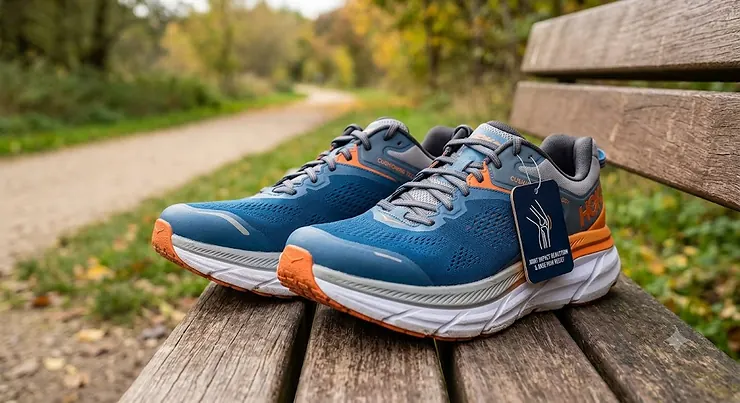
Your knee doesn’t care that you had a great run planned. It just starts talking to you around mile two, and suddenly every step feels like a negotiation. If you’re hunting for cushioned running shoes men knee pain has forced you to think seriously about, you already know the stakes: the wrong pair doesn’t just feel bad, it can turn a hobby you love into something you dread. Cushioned running shoes men knee pain sufferers actually stick with are built around one job — soaking up impact before it reaches your joints, so each landing feels absorbed rather than transmitted straight up your leg.

Quick answer: cushioned running shoes for knee pain are shoes with thick, compliant midsole foam and a wide platform designed to spread and slow the force of each footstrike, reducing the jolt that travels through the shin and knee. That’s the textbook definition, but the real story is more nuanced — as you’ll see in the research-backed sections below, cushioning helps, but it isn’t magic.
If you’ve been searching “running shoes men bad knees” late at night after a rough run, you’re not alone — it’s one of the most common footwear questions out there, and the answer depends more on your specific pain pattern than any single “best” shoe. This guide walks through seven real, current models spanning budget to premium, explains what actually changes at the knee when you switch shoes, and gives you a framework for choosing based on your specific pain pattern, not just marketing copy. We’ll also dig into the biomechanics research on why “softer” doesn’t automatically mean “safer,” because that distinction matters more than any spec sheet.
Quick Comparison Table
| Shoe | Best For | Heel Drop | Stack Height (approx.) | Price Range |
|---|---|---|---|---|
| Brooks Ghost 16 | Budget daily trainer | ~12mm | ~35mm | Under $150 |
| New Balance Fresh Foam X 1080v13 | Plush all-rounder | ~6mm | ~35mm | $150-$170 |
| ASICS Gel-Kayano 32 | Overpronation + knee tracking | ~10mm | ~38mm | $150-$175 |
| Brooks Glycerin 21 | Traditional-drop plush ride | ~10mm | ~37mm | $140-$165 |
| Saucony Triumph 22 | Long-mileage durability | ~10mm | ~38mm | $150-$170 |
| HOKA Bondi 9 | Max cushion, heel strikers | ~4mm | ~37/33mm | $160-$180 |
| New Balance Fresh Foam X More v6 | Lowest drop, top shock absorption | ~3mm | ~42/39mm | $160-$180 |
A quick scan of this table tells you something the spec sheets alone won’t: heel drop varies from a near-zero-drop New Balance Fresh Foam X More v6 to a traditional 12mm on the Brooks Ghost 16, and that range matters more for knee pain than raw stack height does. Lower-drop shoes like the More v6 shift load toward the calves and forefoot, which can ease pressure at the front of the knee for some runners, while higher-drop shoes like the Ghost 16 or Glycerin 21 feel more familiar and may suit runners with limited ankle mobility. Notice, too, that stability isn’t just a “bad knees” fix by default — the ASICS Gel-Kayano 32 earns its spot specifically for overpronation-driven knee tracking issues, not knee pain in general. If you’re specifically hunting for the softest road running shoes men can find in this lineup, the HOKA Bondi 9 and the New Balance Fresh Foam X More v6 are your two strongest candidates, since both prioritize plush, protective landings over speed.
💬 Bookmark this comparison table now — you’ll want to reference it again once you’ve read the full breakdown below!
💬 Just one click — help others make better buying decisions too!😊
Top 7 Cushioned Running Shoes for Men: Expert Analysis
1. Brooks Ghost 16 — best budget daily trainer
The Brooks Ghost 16 has built its reputation on being the shoe you don’t have to think about, and for knee pain sufferers on a budget, that reliability is the whole pitch. Its Segmented Crash Pad — a series of small, independent shock-absorbing sections built into the outsole — flexes to match your specific footstrike rather than forcing one landing pattern on everyone, which in practice means fewer sharp, jarring impacts regardless of whether you land on your heel or midfoot. At around 10 ounces with a roughly 12mm heel drop, the Ghost sits at the traditional end of the cushioning spectrum, and that higher drop can genuinely help runners whose knee pain stems from overstriding correction rather than needing a total gait overhaul. Reviewers consistently note the shoe’s smooth, “nothing special but nothing wrong” ride, which is exactly the kind of unremarkable consistency you want when you’re nursing sensitive joints. First-time buyers with knee sensitivity should know this isn’t a max-cushion shoe — it’s a dependable middle-ground option, which is precisely why it works as a first step before committing to pricier max-stack models. At a price consistently under $150, it delivers legitimate joint protection without the premium price tag of the shoes further down this list.
Pros:
- ✅ Segmented Crash Pad adapts to different footstrike patterns
- ✅ Reliable, consistent ride reviewers rarely complain about
- ✅ Lowest price point of any shoe on this list
Cons:
- ❌ Less max-cushion protection than dedicated recovery shoes
- ❌ Traditional 12mm drop won’t suit runners chasing a lower-drop feel
Price range: generally under $150. Given its combination of durability and knee-friendly shock absorption, it’s one of the strongest value picks on this list.
2. New Balance Fresh Foam X 1080v13 — plush all-rounder with a moderate drop
The 1080v13 splits the difference between a traditional ride and a modern max-cushion feel, which makes it a smart pick for runners who aren’t sure yet what kind of cushioning their knees actually prefer. Its Fresh Foam X midsole compound is noticeably softer underfoot than the Ghost’s, and the roughly 6mm heel drop nudges your landing slightly forward compared to a 12mm shoe, without asking your calves to do all the work like a near-zero-drop shoe would. Based on the spec comparison, this shoe occupies a genuinely useful middle lane: soft enough to feel protective on hard pavement, but not so extreme in geometry that it forces a dramatic gait change while you’re already managing pain. Reviewers frequently highlight the plush, “walking on a cloud” sensation during easy miles, alongside a roomy toe box that several wide-footed runners specifically call out as a fit win. What most buyers overlook about this model is the engineered Hypoknit upper, which flexes with the foot and reduces pressure points that can indirectly cause you to alter your stride to compensate — a subtle but real contributor to knee strain over a long run. It’s a strong option for runners managing everyday soreness rather than a specific diagnosed condition.
Pros:
- ✅ Soft Fresh Foam X midsole feels protective on hard surfaces
- ✅ Moderate 6mm drop bridges traditional and low-drop shoes
- ✅ Roomy, accommodating upper reduces pressure-point compensation
Cons:
- ❌ Less structured than dedicated stability models
- ❌ Softer foam compresses faster under high weekly mileage
Price range: typically in the $150-$170 range. For runners who want plush protection without going full maximalist, this is a dependable everyday value pick.
3. ASICS Gel-Kayano 32 — best for overpronation-related knee tracking
If your knee pain shows up specifically when your foot rolls inward during landing, the Gel-Kayano 32 is built for exactly that scenario. Its 4D Guidance System — a combination of a structured heel counter and directional midsole geometry — gently steers the foot back toward a neutral path instead of locking it rigidly in place, and that’s an important distinction: research and clinical opinion consistently note that overpronation can pull the kneecap slightly off its normal tracking groove, aggravating pain at the front of the knee. Paired with ASICS’ FF Blast Plus foam, the shoe delivers a springy, energy-return-forward ride that doesn’t feel as dead or clinical as older stability shoes once did. Here’s what to weigh: at roughly 10.6 ounces, it’s heavier than several neutral options on this list, which is the trade-off for the extra guidance structure. Aggregated review sentiment frequently praises the improved, less “corrective-feeling” stability compared to earlier Kayano generations, while some longtime wearers note the redesigned upper fits slightly narrower through the midfoot. For runners whose knee pain is tied to gait mechanics rather than pure impact, this is worth prioritizing over a purely cushioned model.
Pros:
- ✅ 4D Guidance System addresses overpronation-driven knee tracking
- ✅ FF Blast Plus foam adds spring without a rigid, dead feel
- ✅ Strong reputation for reducing pronation-related joint strain
Cons:
- ❌ Heavier than neutral cushioned shoes on this list
- ❌ Narrower midfoot fit reported by some longtime wearers
Price range: usually $150-$175. If overpronation is contributing to your knee pain, the stability investment here is well justified.
4. Brooks Glycerin 21 — plush traditional-drop cushioning
The Glycerin 21 is the shoe for runners who want serious cushioning without giving up the familiar heel-to-toe feel they’ve run in for years. Its DNA Loft v3 foam blend is engineered to adapt slightly to each runner’s individual stride and body weight, meaning two different runners in the same shoe can experience a subtly different, personalized level of softness — a detail that matters because knee pain response to cushioning is genuinely individual. Sitting at roughly 10mm of drop and around 9.9 ounces, it keeps a classic geometry while still delivering a noticeably plush landing compared to older Brooks neutral models. Based on the spec comparison, this traditional-drop approach is exactly what runners with limited ankle mobility should be looking for, since forcing a low-drop shoe onto stiff ankles can sometimes shift stress rather than removing it. Reviewers who marathon-train in the Glycerin frequently mention that the cushioning holds its supportive feel deep into long runs, when fatigue-driven form breakdown is most likely to load the knees. What the spec sheet won’t tell you, but reviewers note, is that the shoe runs true to size with a slightly more secure heel lockdown than its plush-shoe competitors, which reduces the kind of in-shoe foot slide that can aggravate joint alignment over multiple hours.
Pros:
- ✅ DNA Loft v3 foam adapts to individual stride and weight
- ✅ Traditional drop suits runners with limited ankle mobility
- ✅ Cushioning holds up well deep into long runs
Cons:
- ❌ Less “bouncy” energy return than max-stack competitors
- ❌ Traditional drop won’t appeal to low-drop loyalists
Price range: typically $140-$165. This is a strong pick for marathon-distance training when knee protection needs to last the whole run.
5. Saucony Triumph 22 — built for durability across high mileage
The Triumph 22 answers a question a lot of the “softest shoe” conversations skip entirely: what happens to your knees when the cushioning degrades? Its PWRRUN PB foam — Saucony’s premium, more resilient compound — is specifically formulated to resist the compression breakdown that cheaper EVA foams suffer after a few hundred miles, which matters enormously for knee pain sufferers because a “dead,” compacted midsole stops absorbing shock the way it did on day one. At roughly 10.6 ounces with about a 10mm drop, it’s not the lightest shoe here, but that weight buys you a notably wide, stable platform underfoot. Reviewers consistently report that the Triumph’s cushioning feels close to new well past the mileage where competing foams start to pack down, and several long-term wearers specifically credit that consistency with fewer flare-ups during marathon training blocks. Here’s what most buyers overlook: a shoe that feels great in the store but breaks down by mile 200 can quietly reintroduce the exact impact problem you bought cushioned shoes to solve. For runners logging 30+ miles a week, that durability curve is arguably more important to knee health than the initial out-of-box softness.
Pros:
- ✅ PWRRUN PB foam resists compression breakdown over time
- ✅ Wide, stable platform for a max-cushion daily trainer
- ✅ Reviewers report cushioning holds up well past typical mileage
Cons:
- ❌ Heavier feel than some neutral competitors
- ❌ Premium foam pushes it toward the top of the price range
Price range: generally $150-$170. For high-mileage runners, this is one of the smarter long-term joint-protection investments on the list.

6. HOKA Bondi 9 — maximum cushion for heel strikers
The Bondi 9 is the shoe most people picture when they hear “max cushion,” and for heel-striking runners managing knee pain, that reputation is largely earned. Its full compression-molded EVA midsole delivers one of the thickest stacks in mainstream running, paired with an early-stage Meta-Rocker geometry that helps roll the foot from heel to toe rather than requiring the ankle and knee to manage that transition unassisted. At a roughly 4mm drop and around 10.7 ounces, the low drop combined with a wide, stable base creates a landing platform that reviewers frequently describe as “floating” rather than “cushioned,” which is a meaningful distinction when you’re bracing for impact on every mile. Reviewers consistently note the shoe’s deliberately slow, protection-first ride — it is not built for speed work, and pushing it into fast intervals defeats the purpose of the design. Many models in the HOKA lineup, including versions of the Bondi, have earned the American Podiatric Medical Association’s Seal of Acceptance, a podiatrist-reviewed recognition given to footwear found to support healthy foot function — worth noting, though it is not a substitute for a professional diagnosis of your specific knee issue. If your knee pain flares hardest on long, easy recovery runs, this is the shoe built specifically for that scenario.
Pros:
- ✅ Thick compression-molded EVA stack maximizes cushioning
- ✅ Early-stage Meta-Rocker smooths the heel-to-toe transition
- ✅ Widely recognized as a top pick for recovery and easy mileage
Cons:
- ❌ Not designed for tempo or speed-focused sessions
- ❌ Bulkier ride than lower-stack neutral competitors
Price range: usually $160-$180. For heel strikers prioritizing comfort over pace, it’s hard to beat.
7. New Balance Fresh Foam X More v6 — lowest drop, top shock absorption
The More v6 takes a different route to knee protection than the Bondi — instead of a moderate drop with maximum stack, it pairs a massive stack height with one of the lowest heel drops in the max-cushion category, and independent lab testing has measured its forefoot shock-absorption performance as among the best of any cushioned trainer tested. That combination shifts load away from the front of the knee and toward the calf and ankle complex, which can be a meaningful relief strategy for runners whose pain is specifically patellar rather than generalized. At roughly 9.9 ounces, it’s surprisingly light for its stack height, and its platform runs noticeably wider than average, giving the foot a stable, secure landing zone even on a very thick midsole. Reviewers highlight the plush, cloud-like ride during recovery and easy-day mileage, though some note the low drop takes an adjustment period for runners coming from traditional 10-12mm shoes — easing into it gradually rather than jumping straight into long runs is the smarter approach. Based on the spec comparison, this is arguably the most “engineered specifically for knee protection” shoe on this list, precisely because the low-drop, high-stack combination targets patellar load directly rather than simply adding generic softness.
Pros:
- ✅ Independently measured top-tier forefoot shock absorption
- ✅ Ultra-low drop shifts load away from the front of the knee
- ✅ Wide platform keeps a huge stack feeling stable, not wobbly
Cons:
- ❌ Low drop requires a gradual transition period
- ❌ Premium pricing puts it at the top of this list
Price range: typically $160-$180. For runners specifically managing patellar pain, this is one of the most purpose-built options available.
Practical Usage Guide: Breaking In Cushioned Shoes the Right Way
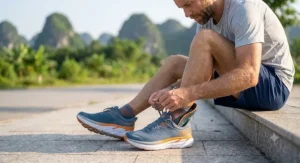
Buying the right shoe is only half the job — how you introduce it to your body matters just as much for your knees. In the first week, wear your new cushioned running shoes men knee pain has made you cautious about for short runs only, ideally 20-30 minutes, so your ankles and calves can adapt to any change in drop before you ask them to carry a long run. A common mistake in the first 30 days is jumping straight from an old, worn-out pair into 8-10 mile runs in a brand-new low-drop model like the New Balance Fresh Foam X More v6 — the muscles around a “new” foot strike pattern need time to strengthen, and skipping that adjustment can shift strain to the knee rather than away from it. Rotate your new shoes with your old pair for the first two to three weeks rather than retiring the old ones immediately; this gradual transition lets you catch any fit or comfort issues before you’re fully committed. For maintenance, most cushioned foams show noticeable compression and reduced shock absorption somewhere between 300 and 500 miles, so tracking mileage (a simple running app or a sticky note in the shoe box works fine) helps you replace shoes before the cushioning quietly stops doing its job. One optimization trick specialty running stores rarely mention: rotating two different pairs — say, a Brooks Ghost 16 for easy days and a HOKA Bondi 9 for recovery runs — spreads impact load across two different midsole geometries, which some research suggests may reduce repetitive-strain injury risk compared to running exclusively in one shoe.
Real-World Scenarios: Matching the Shoe to the Runner
Consider three common profiles. First, the returning runner: a 45-year-old getting back into running after a few sedentary years, running three times a week at an easy pace, budget-conscious, with generalized knee soreness rather than a diagnosed condition. The Brooks Ghost 16 or New Balance Fresh Foam X 1080v13 make sense here — moderate cushioning, forgiving price, and no need to introduce a dramatic gait change on top of everything else that’s new again. Second, the marathon-training overpronator: someone logging 35+ miles a week, whose physical therapist has flagged inward foot roll as a contributor to their knee pain. The ASICS Gel-Kayano 32 is the clear fit, since guidance-focused stability addresses the mechanical root cause rather than just cushioning the symptom. Third, the recovery-day specialist: an experienced runner managing chronic, low-grade patellar discomfort who wants a dedicated shoe purely for slow, protective mileage on hard city pavement. The HOKA Bondi 9 or New Balance Fresh Foam X More v6 both fit that use case, with the choice between them coming down to whether a traditional moderate drop (Bondi) or an aggressively low drop (More v6) feels better on that individual runner’s ankles and calves.
Common Problems and Solutions for Runners With Knee Pain
Problem one: sharp pain specifically at the front of the kneecap during downhill sections. Solution: prioritize a lower-drop, high-cushion shoe like the New Balance Fresh Foam X More v6, since downhill running increases the braking force on the patella and a shoe that shifts load rearward can meaningfully ease that specific pain pattern. Problem two: dull, aching soreness that builds gradually over a long run rather than appearing suddenly. Solution: look at cushioning durability, not just initial softness — the Saucony Triumph 22‘s PWRRUN PB foam is built to resist the mid-run compression that can let impact sneak back in during hour two of a long effort. Problem three: knee pain paired with visible inward ankle roll when you watch yourself run on video. Solution: this is a stability-shoe conversation, and the ASICS Gel-Kayano 32‘s 4D Guidance System is designed specifically for this mechanical pattern rather than cushioning alone. Problem four: pain that appears only after switching to a new pair of shoes. Solution: check the heel-to-toe drop difference between your old and new shoes — a jump of more than 4-6mm in either direction is a common, often-overlooked trigger, and a gradual rotation period (see the Practical Usage Guide above) usually resolves it. Problem five: persistent pain that cushioned shoes alone don’t seem to touch. Solution: this is the point where footwear stops being the answer, and a conversation with a physical therapist or sports medicine physician about gait, strength imbalances, or an underlying diagnosis becomes the genuinely useful next step.
Buyer’s Decision Framework
Use this simple priority checklist to narrow your choice quickly. If your knee pain is generalized soreness and your budget is the top concern, choose a moderate-cushion, moderate-drop shoe like the Brooks Ghost 16 because it delivers dependable shock absorption without asking you to relearn your stride. If you’ve noticed your foot rolling inward on landing, choose a stability shoe like the ASICS Gel-Kayano 32 because guided pronation control addresses a mechanical cause rather than just a symptom. If your pain is specifically at the front of the kneecap and worsens on downhills, choose a low-drop max-cushion shoe like the New Balance Fresh Foam X More v6 because shifting load rearward reduces patellar braking force. If you’re training for long distances and want cushioning that survives the mileage, choose a durability-focused foam like the Saucony Triumph 22‘s PWRRUN PB. And if you simply want the plushest possible landing for slow recovery days, choose a dedicated max-cushion shoe like the HOKA Bondi 9. Running through this checklist before you buy saves you from the expensive trial-and-error cycle of guessing your way through three or four pairs.
How to Choose Cushioned Running Shoes for Knee Pain
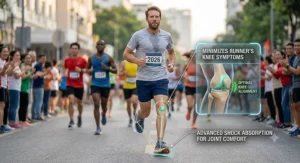
Choosing cushioned running shoes men knee pain has made you cautious about doesn’t have to be a guessing game if you work through these steps in order.
- Identify your pain pattern first. Front-of-knee pain, inner-knee pain, and general soreness each respond differently to cushioning versus stability features, so a quick self-assessment (or a chat with a physical therapist) should come before you shop.
- Check the heel-to-toe drop, not just the stack height. A thick midsole with a high drop behaves very differently at the knee than the same thickness with a near-zero drop.
- Match stability features to your gait, not your pain alone. Overpronation and neutral gaits benefit from genuinely different shoe categories.
- Prioritize foam durability for high mileage. A softer shoe that compresses fast can reintroduce the exact impact problem you were trying to solve.
- Get a proper fit, including width. A cushioned shoe that’s too narrow can cause you to subtly alter your landing to relieve pressure, indirectly loading the knee.
- Transition gradually. Rotating a new pair in slowly protects against the adjustment-period strain covered in the Practical Usage Guide above.
- Treat shoes as one part of a bigger plan. Strength work, running form, and — when needed — professional guidance matter as much as footwear.
Common Mistakes When Buying Shoes for Knee Pain
The single most common mistake is assuming “more cushion” is automatically “less impact.” As the research below on impact attenuation shows, that assumption doesn’t always hold up biomechanically. A second frequent error is buying based on a single flashy spec — like an eye-catching stack height — without checking heel drop, which arguably matters more for knee-specific pain. A third mistake is ignoring width and toe-box shape; a shoe that pinches can cause subtle compensatory landing changes that undo whatever cushioning benefit you paid for. A fourth is skipping the break-in period entirely and jumping straight into long runs, which is exactly the scenario the Practical Usage Guide above warns against. Finally, many runners treat shoe shopping as a permanent fix rather than one tool among several — strength training, mobility work, and gradual mileage increases all matter just as much as the shoe on your foot.
Cushioned Shoes vs Minimalist Shoes for Knee Pain
The cushioned-versus-minimalist debate isn’t settled the way marketing on either side likes to suggest. Minimalist and barefoot-style shoes proponents argue that thin soles encourage a more natural, midfoot-forward strike that reduces the exaggerated heel-first landing associated with knee strain — and there’s some biomechanical logic there. However, actual laboratory research complicates the simple “cushioned = safer” narrative from the other direction too: a widely cited running biomechanics study published in Scientific Reports found that highly cushioned maximalist shoes can actually increase leg stiffness and amplify impact loading rather than reduce it, particularly at faster running speeds, because runners subconsciously adjust their stride to compensate for a softer landing surface. The honest takeaway is that neither extreme is a guaranteed fix — a well-fitted cushioned shoe with a drop and stability profile matched to your specific gait usually outperforms both the softest max-cushion model and the thinnest minimalist shoe when it comes to actual knee comfort over time.
What to Expect: Real-World Performance
On paper, spec sheets promise smooth, pain-free miles, but the everyday experience is a little more textured than that. Expect the first few runs in a new cushioned shoe to feel noticeably different underfoot — softer landings, a slightly altered sense of ground contact — before your legs adapt to the new midsole and geometry. Expect long runs to reveal a shoe’s true character more than short test jogs ever will, since fatigue late in a run is when form breaks down and knee-loading patterns shift the most. Expect max-cushion shoes like the HOKA Bondi 9 to feel genuinely protective on hard pavement but noticeably sluggish if you try to push pace, because that soft, high-stack platform trades responsiveness for shock absorption. And expect impact attenuation to feel real in a controlled test but be harder to notice mile-to-mile in daily running, since your body’s own leg-stiffness adjustments (as covered in the comparison section above) partially offset the cushioning benefit at higher speeds. Realistic expectations here prevent the common letdown of assuming a shoe alone will erase pain that also has form, strength, or training-load contributors.
Long-Term Cost and Maintenance for Knee-Friendly Shoes
Thinking in cost-per-mile rather than sticker price changes the calculus considerably. A Brooks Ghost 16 at under $150 that reliably lasts 400 miles works out to roughly 35-40 cents per mile, while a premium New Balance Fresh Foam X More v6 at the top of its price range, if its foam holds protective cushioning for a similar mileage window, lands in a comparable range once you account for the durability differences noted earlier for foams like Saucony’s PWRRUN PB. The real long-term cost of ignoring foam breakdown isn’t measured in dollars, though — it’s measured in the knee strain that creeps back in once a “dead” midsole stops absorbing shock the way it did new. A simple maintenance habit — rotating two pairs, tracking mileage, and retiring shoes proactively rather than reactively — is one of the cheapest, most effective knee-protection strategies available, and it costs nothing beyond the shoes you’d be buying anyway.
Features That Actually Matter (And Those That Don’t)
Heel-to-toe drop matters enormously for knee-specific pain, far more than most marketing copy suggests, because it directly changes where along the leg impact force gets distributed. Foam durability matters just as much as initial softness, since a compressed, “dead” midsole stops protecting your knees regardless of how plush it felt on day one. A wide, stable platform matters for confidence and injury prevention, especially in max-stack shoes where a narrow base can feel wobbly at height. For runners specifically comparing max cushion shoes men joint protection needs have pushed them toward, the drop-and-durability combination matters more than raw stack height alone — a taller midsole isn’t automatically the better joint-protection choice if the drop and platform width aren’t matched to your gait. On the other hand, flashy carbon plates and race-day propulsion technology — while genuinely useful for competitive speed — matter far less for knee pain management than the fundamentals above, and in some cases the stiffer, more aggressive ride of a plated racing shoe can actually work against a knee-pain-focused runner. Similarly, color, brand prestige, and marketing buzzwords like “next-gen” or “revolutionary” tell you nothing about how a shoe will actually feel on your knees at mile six of a Tuesday morning run — always check the actual heel drop and cushioning compound specs instead of the ad copy.
Chondromalacia Patellae and Running: What Runners Should Know
If your knee pain sits specifically behind or around the kneecap and worsens with stairs, squatting, or long periods sitting with a bent knee, it’s worth knowing about chondromalacia patellae, a condition involving softening and irritation of the cartilage on the underside of the kneecap. According to Wikipedia’s overview of the condition, the cartilage there normally acts as a natural shock absorber, and repetitive overuse or biomechanical stress can cause it to break down, making movement painful. Medical reference sources including the NIH’s clinical overview via StatPearls note that this condition — sometimes also called patellofemoral pain syndrome or “runner’s knee” — is closely tied to how the kneecap tracks within its groove during activity, which is exactly why gait-correcting stability shoes like the ASICS Gel-Kayano 32 are worth considering for runners whose pain fits this pattern. Cushioned running shoes men knee pain of this specific type has affected can genuinely help by reducing the force reaching the joint, but footwear is a management tool, not a diagnosis or a cure — persistent pain in this area is worth discussing with a doctor or physical therapist rather than solving with shoes alone.
Low-Impact Running Form for Knee Protection
Shoes handle part of the impact equation, but your running form handles the rest, and adopting a genuinely low-impact running form can meaningfully reduce the load your knees absorb on every stride regardless of which shoe you’re wearing. Shortening your stride slightly and increasing your cadence — aiming for roughly 170-180 steps per minute rather than a long, reaching stride — tends to reduce the braking force that occurs when the foot lands well ahead of the body’s center of mass. Landing with a slight forward lean from the ankles, rather than the hips, keeps your foot striking closer beneath you, which is one of the most consistently cited form adjustments for reducing knee-loading forces. Avoiding a hard, locked-knee landing by keeping a small, natural bend in the knee at footstrike also helps the leg act more like a spring and less like a rigid pillar transmitting shock straight upward. None of this replaces good footwear, but pairing a genuinely low-impact running form with a shoe suited to your gait — say, the New Balance Fresh Foam X More v6 for a low-drop, forward-shifted stride — tends to produce noticeably better results than either change made in isolation.
Frequently Asked Questions
Below are the questions we hear most often about cushioned running shoes men knee pain concerns bring up, answered straight and short.
❓ Do cushioned running shoes actually help with knee pain?
❓ What heel drop is best for knee pain?
❓ Are stability shoes better than neutral cushioned shoes for knee pain?
❓ How often should I replace running shoes if I have knee pain?
❓ Can the wrong running shoes cause knee pain?
Conclusion
There’s no single “best” shoe in this list — there’s only the one that matches your specific pain pattern, gait, and mileage goals. If you’re managing generalized soreness on a budget, the Brooks Ghost 16 is a smart, low-risk starting point. If overpronation is part of your picture, the ASICS Gel-Kayano 32 earns its higher price tag. And if you’re chasing the most purpose-built patellar protection available, the New Balance Fresh Foam X More v6 and the HOKA Bondi 9 represent two genuinely different, well-engineered approaches to the same goal. What all seven of these cushioned running shoes men knee pain sufferers have come to rely on share is real, sourced engineering behind the cushioning claims — not just soft foam and a marketing story. Combine the right shoe with the low-impact running form adjustments and gradual break-in approach covered above, and you give your knees the best realistic shot at pain-free miles.
✨ Don’t Miss These Exclusive Deals!
🔍 Ready to protect your knees on every run? Click on any highlighted shoe above to check current pricing and availability. The right pair could be the difference between dreading your next run and actually looking forward to it!
Recommended for You
- Max Cushion Running Shoes for Men: 7 Comfort Champions (2026)
- Motion Control Shoes for Heavy Male Runners: 7 Best Picks (2026)
- Motion Control vs Stability Running Shoes Men: 7 Best Picks for 2026
Disclaimer: This article contains affiliate links. As an Amazon Associate, I earn from qualifying purchases. If you purchase products through these links, we may earn a small commission at no additional cost to you.
✨ Found this helpful? Share it with your friends! 💬🤗
