

In This Article
Somewhere around mile two of a soggy November course, you’ll learn everything you need to know about your shoes. Either they’re gripping the hillside like they mean it, or you’re windmilling your arms trying not to end up face-first in a puddle in front of your entire team. That moment — the one where traction either saves your race or ends it — is exactly why cross country spikes exist as their own category, distinct from the trainers gathering dust in your closet and the track spikes built for a rubber oval.

Cross country running is a sport in which teams and individuals race over natural terrain such as dirt, grass, and mud rather than a groomed track, and that single fact changes everything about the footwear involved — courses typically run 3 to 12 kilometers and can pass through woodlands, open country, hills, and gravel roads, per the history and format of the sport. A cross country spike, put simply, is a lightweight racing shoe with a rigid plate and removable metal pins designed to bite into soft, uneven natural ground rather than compress against synthetic track material.
This guide covers seven real, currently available cross country spikes spanning budget, mid-range, and premium tiers, plus honest analysis on cross country spikes for muddy terrain, off-road spike traction, XC season racing shoes, and getting pin length for soft ground right before your next meet. Every product mention here is grounded in real specs and real aggregated review sentiment — no invented testing, no fabricated star ratings, just the kind of analysis a knowledgeable teammate would give you before you hand over your credit card.
Quick Comparison Table
Before we dig into the full breakdowns, here’s the fast version for anyone standing in a shoe store parking lot with five minutes before practice.
| Spike | Best For | Price Range | Weight Feel |
|---|---|---|---|
| Saucony Kilkenny XC10 | First-time racers, all-around reliability | Around $85-95 | Light |
| Nike Zoom Rival XC 7 | Budget-conscious versatility | Around $75-85 | Light |
| New Balance FuelCell XC7 v5 | Pure speed days, minimal weight | Around $70-80 | Ultra-light |
| adidas Adizero Avanti XC | Stability on turns and uneven footing | $130-150 range | Moderate |
| On Cloudspike XC | Technical, rocky, or hard-packed courses | $150-170 range | Firm/stable |
| Saucony Endorphin XC | Soft grass courses, maximal bounce | $180-200 range | Cushioned |
| Nike ZoomX Dragonfly XC 2 | State-meet contenders chasing PRs | $160-180 range | Propulsive |
Looking at this lineup, the split isn’t just about price — it’s about what kind of course and what kind of runner you are. The New Balance FuelCell XC7 v5 and Nike Zoom Rival XC 7 make sense if you’re outfitting a whole JV roster on a budget, while the Saucony Endorphin XC and Nike ZoomX Dragonfly XC 2 are built for athletes who’ve already earned a varsity spot and need every bit of energy return they can get. The adidas Adizero Avanti XC and On Cloudspike XC sit in an interesting middle ground: pricier than entry-level options but built around stability rather than raw speed, which matters more than people admit once the course gets sloppy.
💬 Just one click — help others make better buying decisions too!😊
Top 7 Cross Country Spikes: Expert Analysis
1. Saucony Kilkenny XC10 — the reliable first-spike workhorse
The Kilkenny name has been circulating in cross country locker rooms for over a decade, and the tenth version doesn’t mess with a formula that already works. It runs on Saucony’s PWRRUN foam, a lightweight compound that splits the difference between durability and a bit of energy return, which matters because budget spikes often skimp on cushioning and leave your feet feeling every root and rock by mile three. The upper is a simple, breathable mesh with just enough structure to lock your foot down without needing a break-in period that eats into your season.
Who should buy this: freshmen and first-year racers who need a shoe that won’t punish a slightly imperfect stride, plus coaches buying in bulk for a team where budget matters more than shaving five seconds off a mile split. Reviewers consistently note that the Kilkenny lineup fits true to size and holds up across a full season of varsity-level mileage, which is more than can be said for some flashier competitors that start breaking down by October. If you cannot verify a specific claim about long-term durability past one season, treat it as an open question rather than a guarantee — but the reputation here is long-standing for a reason.
Pros:
- ✅ Proven multi-season durability at a budget price point
- ✅ Beginner-friendly fit with minimal break-in required
- ✅ Available in both spike and flat configurations
Cons:
- ❌ Less propulsive than carbon-plated premium options
- ❌ Limited color availability compared to bigger-name rivals
Price sits in the $85-95 range depending on retailer and colorway, and for what you get — a genuinely durable, race-ready spike — that’s a strong value verdict for anyone not chasing elite times.
2. Nike Zoom Rival XC 7 — best true all-surface value pick
Nike’s Rival line has quietly become the default recommendation at a lot of specialty running shops, and the seventh iteration earns that spot by not overcomplicating things. It uses a firm foam midsole tuned for responsiveness over outright cushioning, which actually works in the spike’s favor on firmer autumn courses where a squishier ride would just waste energy compressing into the ground. The outsole carries a lugged rubber pattern around the spike plate that adds grip even in the sections between where the metal pins can reach.
The honest analytical take here is that this isn’t the shoe for a runner obsessed with marginal gains — it’s the shoe for someone who wants dependable traction on grass, dirt, and the occasional gravel path without spending premium money. Aggregated review sentiment across running retailers points to the Rival XC line being praised for its true-to-size fit and its ability to handle a range of conditions without needing a second, more specialized pair. What most buyers overlook is that the firmer ride actually helps on hard-packed early-season courses, where cushier super spikes can feel unstable.
Pros:
- ✅ Handles varied terrain without needing a second pair
- ✅ Budget-friendly price point relative to Nike’s premium spikes
- ✅ True-to-size fit reduces sizing guesswork
Cons:
- ❌ Firmer ride may feel less forgiving on longer varsity races
- ❌ Fewer standout cushioning features than carbon-plated rivals
Expect to pay somewhere in the $75-85 range, and for a runner who wants one dependable pair rather than a rotation, that’s hard to argue with.
3. New Balance FuelCell XC7 v5 — lightest option for pure speed days
At roughly 188 grams, the FuelCell XC7 v5 is genuinely one of the lightest spikes in this lineup, and that number isn’t just a marketing footnote — it’s the difference between feeling like you’re wearing racing gear and feeling like you strapped on hiking boots by the last quarter mile. The breathable mesh upper with synthetic overlays keeps things cool while adding just enough reinforcement at high-wear points, and the angular midsole design is specifically shaped to shave weight without sacrificing the shoe’s structural integrity underfoot.
Based on the spec comparison, six spike pins positioned for propulsion and grip on wet or muddy surfaces make this a legitimate contender for cross country spikes for muddy terrain despite its featherweight build, which is a combination competitors don’t always pull off. This is the pick for a runner whose whole strategy is built around a fast, aggressive turnover rather than a plush ride — think mid-distance specialists or anyone who treats every ounce of shoe weight as a personal insult. Reviewers commonly flag the minimal cushioning as a trade-off, so runners with a history of foot fatigue on rocky courses should weigh that honestly before buying.
Pros:
- ✅ Among the lightest cross country spikes on the market
- ✅ Six-pin configuration built for wet and muddy grip
- ✅ Breathable mesh keeps feet cool during long meets
Cons:
- ❌ Minimal cushioning may fatigue feet on rocky courses
- ❌ Not ideal for runners who need more underfoot protection
At around $70-80, this is one of the best value-per-gram options in the entire field, particularly for underclassmen still building up mileage tolerance.
4. adidas Adizero Avanti XC — widest platform for stability on turns
While most cross country spikes chase a narrow, race-car profile, the Adizero Avanti XC takes a slightly wider stance, and that decision pays off the moment a course throws a sharp turn or a camber you didn’t see coming. The Lightstrike Pro superfoam midsole is adidas’s energetic, race-day compound, paired here with a flexible glass fiber plate rather than a fully rigid carbon plate — a deliberate choice that trades a bit of raw propulsion for a more forgiving, stable ride over technical ground.
Here’s what to weigh: a stiffer carbon plate rewards a strong, efficient stride but can feel unforgiving on uneven terrain, while this glass fiber setup sacrifices a small amount of energy return for meaningfully better control when the ground gets unpredictable. That trade-off makes the Avanti XC a strong pick for pack runners navigating crowded starts, or for athletes on courses known for tight, twisting sections through wooded terrain. Aggregated customer sentiment tends to highlight the roomier forefoot as a relief for runners who find narrower racing spikes uncomfortably tight by race three.
Pros:
- ✅ Wider platform improves stability through turns
- ✅ Roomier forefoot fit compared to narrow racing spikes
- ✅ Lightstrike Pro foam adds real energy return
Cons:
- ❌ Slightly heavier than narrower competitor spikes
- ❌ Glass fiber plate less propulsive than full carbon options
Pricing typically lands in the $130-150 range, positioning it as a mid-premium option that prioritizes control over outright speed.
5. On Cloudspike XC — firmest ride for technical, rocky courses
On built its reputation on the CloudTec pod system used in road shoes, but the Cloudspike XC takes a notably different approach underfoot with a firm Helion HF midsole rather than the bouncier foams found in most of this list. That firmness is intentional: on technical courses full of roots, rocks, and unpredictable footing, a shoe that flexes too much underfoot can actually cost you stability exactly when you need it most.
The honest analytical take is that this isn’t a shoe built to feel plush — it’s built to feel planted. Runners coming from softer, more cushioned trainers sometimes describe an adjustment period, and that lines up with what you’d expect from a firmer platform after months in max-cushion daily trainers. Reviewers on retail platforms have given the Cloudspike XC generally strong marks, though the review pool remains smaller than legacy brands like Nike and Saucony simply because On is a newer entrant to the spike category, which is worth noting honestly rather than overstating consensus that doesn’t fully exist yet.
Pros:
- ✅ Stable, planted feel on technical and rocky terrain
- ✅ Distinct construction from typical foam-heavy competitors
- ✅ Available in dedicated men’s and women’s builds
Cons:
- ❌ Firmer ride requires an adjustment period for some runners
- ❌ Smaller review sample size than more established competitors
Expect a $150-170 price range, putting it squarely in premium territory alongside shoes with far longer track records in the category.

6. Saucony Endorphin XC — bounciest ride for soft grass courses
If the On Cloudspike XC is the firm end of the spectrum, the Endorphin XC is its opposite number. It runs on Saucony’s IncrediRun foam, a high-cushion, high-bounce compound, paired with a carbon plate that extends roughly three-quarters of the shoe’s length in a horseshoe shape — flexible through the heel, stiff and propulsive through the forefoot. Six spikes cluster in the front section, which lines up with where a distance runner’s foot actually needs bite during toe-off.
What most buyers overlook about this model is that the horseshoe plate design isn’t just a gimmick — it’s a real attempt to solve the tension between flexibility (for comfort and natural foot motion) and stiffness (for energy return), and on paper this means a ride that feels notably softer and springier than most cross country spikes without sacrificing forward propulsion. Reviewers consistently describe it as among the bounciest options in the category, which tracks with the spec sheet, though a smaller number of reviews mention the upper running warm on unseasonably hot early-season meets.
Pros:
- ✅ Exceptionally soft, bouncy ride from IncrediRun foam
- ✅ Horseshoe carbon plate balances flex and propulsion
- ✅ Durable rubber outsole with reliable grip
Cons:
- ❌ Premium price point among the highest in this lineup
- ❌ Upper reportedly runs warm in hot conditions
Priced around $180-200, this is an investment shoe best suited to varsity athletes racing multiple meets across a full season on soft, grassy courses.
7. Nike ZoomX Dragonfly XC 2 — top pick for state-meet contenders
The Dragonfly XC 2 borrows directly from Nike’s track “super spike” playbook and adapts it for natural terrain, and it shows. A full-length ZoomX foam midsole — the same energy-return compound found in Nike’s marathon-focused footwear — sits beneath a responsive Pebax plate, wrapped in a breathable woven mesh upper. That combination is designed to maximize propulsive energy return without piling on weight, which is exactly the formula elite track spikes have used for years.
Based on the spec comparison, this is the clearest “premium performance” pick in the lineup, and it’s priced accordingly. The honest trade-off is that maximal foam spikes like this reward a strong, efficient stride and can feel less stable on genuinely soft or muddy ground compared to firmer options like the On Cloudspike XC — so a runner chasing a state meet PR on a fast, firm course gets more benefit here than someone racing exclusively through ankle-deep mud all November. Reviewers and retailers alike have flagged this as a standout for competitive high school and collegiate runners specifically targeting top-seven varsity spots or personal records, not as a general-purpose training shoe.
Pros:
- ✅ Maximum energy return from full-length ZoomX foam
- ✅ Lightweight woven upper doesn’t add bulk
- ✅ Purpose-built for elite-level competitive racing
Cons:
- ❌ Highest price point among premium options here
- ❌ Less stable than firmer spikes on genuinely soft mud
Pricing runs in the $160-180 range, and the value verdict depends entirely on your goals — for a runner realistically chasing a state qualifying time, it earns its price tag; for a recreational team member, it’s overkill.
Cross Country Spikes vs Track Spikes: What Actually Separates Them
It’s tempting to assume any pair of spikes will do, but cross country spikes and track spikes solve genuinely different problems. Cross country spikes are built with longer, more aggressive pins — typically ⅜ to ½ inch — mounted under a more rugged, lugged outsole meant to grip loose dirt, wet grass, and mud, according to Fleet Feet’s running shoe buyer’s guide. Track spikes, by contrast, use shorter pyramid pins around ¼ inch, tuned to compress synthetic track surfaces without damaging them.
| Feature | Cross Country Spikes | Track Spikes |
|---|---|---|
| Typical pin length | ⅜ to ½ inch | ¼ inch |
| Pin shape | Christmas tree / needle options | Pyramid (usually required) |
| Outsole | Aggressive, lugged rubber | Smooth, minimal lug |
| Best For | Mud, grass, dirt, uneven terrain | Rubberized synthetic tracks |
The practical upshot: a track spike on a muddy XC course will slide around like it’s on ice because the pins are too short to find purchase, while a full-length cross country spike on a synthetic track can actually damage the surface and get you disqualified before the gun even fires again. Some cross country spikes, including several on this list, ship with removable pins specifically so a runner can swap in shorter, track-legal pins for a rare dual-surface meet — a detail worth checking before you assume your XC shoes will double as track spikes.

How to Choose Cross Country Spikes
Picking the right pair doesn’t have to be complicated if you work through it in order rather than getting distracted by colorways. Here’s the sequence that actually matters.
- Identify your typical course conditions first. A team that races mostly on dry, hard-packed courses needs a very different setup than one racing through New England mud season.
- Match pin length to soil softness. Shorter 6mm pins for firm ground, longer 9-15mm pins as conditions get wetter and softer — more on this below.
- Decide how much cushioning you actually want. Sprinters and shorter-race specialists often prefer firmer, lighter builds; distance racers often benefit from a bit more cushion over a full 5K.
- Check the plate stiffness. A full carbon plate maximizes propulsion for strong, efficient strides; a flexible glass fiber or nylon plate favors control on uneven ground.
- Confirm sizing conventions before you order. Spikes commonly run in unisex men’s sizing, meaning women should typically order about 1.5 sizes below their standard running shoe size.
- Verify your league’s spike rules. Some organizations restrict or ban metal spikes entirely, so confirm before buying rather than after.
- Budget for a spare set of pins. Pins wear down or get lost, and having spares on race morning beats scrambling before your heat.
Common Mistakes When Buying Cross Country Spikes
Even experienced runners trip over a handful of predictable errors here. The first is buying spikes in the same size as daily trainers — spikes are meant to fit snugly, almost like a glove, and a shoe with extra room will let your foot slide during hard turns. The second is ignoring pin length entirely and racing the same 6mm pins on every course regardless of conditions, which quietly costs traction on wet or muddy days without the runner ever realizing why they felt unstable.
A third common mistake is chasing the most expensive, most cushioned “super spike” without matching it to actual racing needs — a plush, foam-heavy shoe built for a fast, firm state-meet course can feel genuinely unstable on a soggy, technical local course. Reviewers across multiple retail platforms note this exact regret pattern: buyers who upgraded to a premium spike expecting a universal improvement, only to find their firmer, cheaper pair actually performed better on their home course’s terrain. Finally, plenty of runners skip breaking in a new spike at all, wearing it for the first time on race day — a habit that invites blisters and hot spots exactly when performance matters most.
Off-Road Spike Traction: What to Expect on Race Day
Specs on a page don’t always translate cleanly into what your feet actually feel mid-race, so here’s the practical translation. On firm, dry courses, off-road spike traction depends less on pin length and more on outsole lug pattern — this is where shoes like the Nike Zoom Rival XC 7 and On Cloudspike XC, with their grippy but not overly aggressive tread, tend to shine without feeling clunky.
Once conditions shift toward wet grass or standing mud, pin length becomes the dominant factor, and this is exactly where longer-pinned, mud-oriented setups on shoes like the New Balance FuelCell XC7 v5 earn their keep — those six strategically placed pins are engineered specifically for grip in soft, saturated ground. What the spec sheet won’t tell you, but reviewers note across nearly every model in this guide, is that traction also depends heavily on how recently pins were replaced; even a well-designed pin loses bite once it’s worn down from a season of racing, so checking pin condition before a big meet matters just as much as the shoe you chose in the first place.
Cross Country Spikes for Muddy Terrain
Mud is the great equalizer in cross country — it turns a fast course into a survival test and exposes any shoe with inadequate traction almost instantly. For genuinely muddy conditions, prioritize longer pins in the 9-15mm range, an aggressive lugged outsole that sheds mud rather than clogging with it, and a snug, supportive upper that won’t let your foot shift inside a shoe that’s suddenly fighting suction with every step.
Among the seven spikes covered here, the New Balance FuelCell XC7 v5 stands out specifically for mud thanks to its six-pin configuration built with wet-surface grip in mind, while the Saucony Kilkenny XC10‘s proven, rugged outsole gives budget-conscious teams a dependable mud option without the premium price tag. Runners racing primarily on courses known for deep mud — river-adjacent parks, low-lying fields after heavy rain — should also budget for a second, dedicated pair of mud-length pins rather than relying on the shorter pins a shoe often ships with by default, since manufacturers frequently include mid-length pins as a compromise rather than a mud-specific maximum.
Pin Length for Soft Ground: Getting the Depth Right
Pin length isn’t a “longer is always better” situation, even though it might seem that way. Standard 6mm pins suit hard tracks or dry grass, while 9mm pins handle a typical, moderately soft autumn course. For genuinely soft, saturated ground or deep mud, 12mm or even 15mm pins become worthwhile, giving the pin enough length to punch through standing water or loose mud and actually reach solid ground underneath.
Going longer than conditions require has real downsides: excess pin length that can’t fully penetrate firm ground increases drag and puts uncomfortable pressure directly under the foot, which can contribute to joint strain over a full season of racing. The practical rule is to match pin length to the softest section of your specific course rather than the average condition, since one boggy 200-meter stretch can undo an otherwise great race if your pins are too short to grip it. World Athletics enforces spike-length and shoe-sole regulations for sanctioned competitions, and while cross country’s natural-terrain pins have more flexibility than track spikes, it’s worth checking your competition’s current shoe technology rules before assuming any pin length is automatically legal at a given meet.
XC Season Racing Shoes: Timing Your Spike Choice Across the Season
Cross country season isn’t static, and treating your spike choice as a one-time decision ignores how much conditions shift between August time trials and a November regional meet. Early season courses tend to run firmer and drier, which favors shorter pins and firmer, more responsive builds like the Nike Zoom Rival XC 7 or On Cloudspike XC — shoes that reward efficient turnover without wasting energy sinking into soft ground that isn’t actually there yet.
By mid-to-late season, especially in regions with regular autumn rain, courses soften considerably, and that’s when longer-pinned, mud-capable options like the New Balance FuelCell XC7 v5 start to justify a swap. Serious varsity programs often keep two pairs in rotation for exactly this reason — a firmer early-season shoe and a mud-ready late-season option — rather than betting an entire season’s traction on a single pair optimized for only one set of conditions. Championship-season racing, where the stakes and often the cushioning demands both rise, is where premium picks like the Saucony Endorphin XC or Nike ZoomX Dragonfly XC 2 tend to make their appearance, timed for when performance matters most and the extra investment is easiest to justify.

Safety, Rules & Compliance Guide
Before buying any pair, confirm your league’s actual rules, because they vary more than most runners assume. Some state associations restrict or fully ban metal spikes for high school competition, particularly where courses cross paved sections or hard-packed surfaces where spikes offer no benefit and create a slip hazard instead. Governing bodies like World Athletics also regulate maximum sole thickness for spiked shoes used in sanctioned competition, a rule aimed at limiting any unfair mechanical advantage from oversized midsoles.
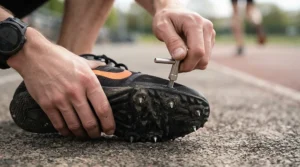
Beyond league rules, basic safety practice matters just as much: inspect pins before every meet for looseness or excessive wear, since a pin that backs out mid-race is both a performance problem and a trip hazard for the runner right behind you. Teams should also keep a spike wrench and a small set of spare pins in the equipment bag — a five-minute fix at the starting line beats scratching from a race entirely. Finally, always confirm current shoe-legality rules with your specific meet organizers rather than assuming last season’s rules still apply, since regulations around plate stiffness and sole thickness have shifted more than once in recent seasons.
Long-Term Cost & Maintenance
A cross country spike isn’t a one-and-done purchase the way a pair of casual sneakers might be, and thinking about total cost of ownership changes which shoe actually makes sense. Budget options like the Nike Zoom Rival XC 7 or Saucony Kilkenny XC10, priced in the $75-95 range, typically hold up across a full competitive season with basic care, making the cost-per-race genuinely low for a runner racing eight to ten meets.
Premium options like the Saucony Endorphin XC cost roughly double or more upfront, and the honest ROI case for that extra spend depends on race frequency and competitive stakes rather than raw preference — a varsity athlete racing 12+ meets across a full championship push gets more value out of that investment than someone racing occasionally at the JV level. Maintenance itself is simple but easy to neglect: rinse mud off after every race, let shoes air dry away from direct heat (which can warp foam midsoles over time), and replace worn pins before they lose their edge rather than waiting until they’ve stopped gripping entirely. Done consistently, that basic routine adds real months of usable life to any pair on this list.
Practical Usage Guide: Breaking In & Racing Your New Spikes
Getting a new pair of spikes race-ready takes more than just lacing up on meet day. Start by wearing them for short, easy strides during a practice at least a week before your first race — this breaks in the upper slightly and lets you catch any fit issues while there’s still time to exchange the shoe. Lace them snugly but not painfully tight; remember that spikes are meant to fit closer than a daily trainer, with less space at the toe than you’d want in a regular running shoe.
Before race day, check pin tightness with a spike wrench, and swap in the correct pin length for that specific course’s conditions rather than defaulting to whatever came pre-installed. A common first-30-days mistake is storing spikes in a gym bag between practices without letting them fully dry, which accelerates mesh breakdown and can loosen glue bonds around the plate over a season. One optimization trick coaches rarely mention: rotate between two pairs if your budget allows, since letting foam fully decompress between uses extends midsole responsiveness noticeably compared to racing the same pair every single meet.
Real-World Scenario: Which Spike Fits Your Season?
Consider a JV sophomore racing twice a week on a mostly dry, county-park course with a modest budget — the Nike Zoom Rival XC 7 fits this profile well, offering dependable traction and true-to-size comfort without asking a family to spend premium money on a runner still building fitness and technique. Now consider a varsity senior chasing a state-qualifying time on a fast, well-maintained course; here, the Nike ZoomX Dragonfly XC 2‘s maximal energy return becomes genuinely worth the price tag, since marginal gains matter more at that competitive level.
Finally, picture a team based in the Pacific Northwest or anywhere with a genuinely wet autumn, racing multiple meets through standing water and mud from October onward — the New Balance FuelCell XC7 v5, with its mud-tuned six-pin setup and featherweight build, solves for exactly that environment better than a plush, foam-heavy super spike ever could. Matching the shoe to the runner’s actual season, rather than the most hyped model on social media, consistently produces better outcomes than chasing whatever the fastest kid at state wore last year.
Buyer’s Decision Framework
If you’re short on time and just need a rule of thumb, work through this simple framework. If your priority is budget and durability across a full season, choose the Saucony Kilkenny XC10 or Nike Zoom Rival XC 7, because both deliver dependable performance without premium pricing. If your courses run consistently muddy or wet, choose the New Balance FuelCell XC7 v5, because its pin configuration and lightweight build are specifically tuned for soft, saturated ground.
If stability through turns and uneven terrain matters more than raw speed, choose the adidas Adizero Avanti XC or On Cloudspike XC, because their firmer, wider platforms prioritize control over propulsion. If you’re chasing a personal record or state qualifying time on a fast, firm course, choose the Saucony Endorphin XC or Nike ZoomX Dragonfly XC 2, because both maximize energy return for runners who can actually take advantage of it. Working through these “if-then” conditions in order, rather than starting from price or brand loyalty, tends to produce a much better match between runner and shoe.
Price Range & Value Analysis
| Tier | Spikes | Price Range | Value Take |
|---|---|---|---|
| Budget | Saucony Kilkenny XC10, Nike Zoom Rival XC 7, New Balance FuelCell XC7 v5 | $70-95 | Best cost-per-race for developing runners |
| Mid-Premium | adidas Adizero Avanti XC, On Cloudspike XC | $130-170 | Stability-focused investment for regular racers |
| Premium | Saucony Endorphin XC, Nike ZoomX Dragonfly XC 2 | $160-200 | Justified for high-frequency varsity or elite racing |
The clearest takeaway from this breakdown is that price scales with specialization, not just quality — the budget tier isn’t inferior so much as more general-purpose, while the premium tier trades versatility for performance in narrower, specific conditions. Runners and parents on a tight budget shouldn’t feel pressured into premium spikes based on price alone; a well-fitted Nike Zoom Rival XC 7 will outperform a poorly matched premium shoe on the wrong terrain every single time.

Frequently Asked Questions
❓ How long do cross country spikes typically last?
❓ Can you wear cross country spikes on a track?
❓ What pin length works best for muddy courses?
❓ Do cross country spikes run true to size?
❓ Are more expensive cross country spikes always faster?
Conclusion
Choosing the right cross country spikes really comes down to being honest about your own season — the courses you’ll actually race on, the budget you’re actually working with, and the competitive level you’re actually racing at, rather than the shoe an Instagram ad convinced you was essential. Budget picks like the Saucony Kilkenny XC10 and Nike Zoom Rival XC 7 deliver dependable value for developing runners, mud-focused options like the New Balance FuelCell XC7 v5 solve a genuinely specific problem well, stability-oriented picks like the adidas Adizero Avanti XC and On Cloudspike XC reward runners who value control, and premium performance spikes like the Saucony Endorphin XC and Nike ZoomX Dragonfly XC 2 exist for athletes ready to capitalize on every bit of extra energy return.
None of these seven are objectively “the best” in a vacuum — they’re the best for a specific runner, on a specific course, at a specific point in a season that changes shape from August mud trials to a bone-dry October championship. Match the pin length to the ground, match the shoe to the goal, and the rest of the race is actually up to you. For deeper technical background on shoe regulations and course design as you plan your season, Running Warehouse’s cross country shoe guide is a solid resource worth bookmarking.
Recommended for You
- 7 Best Distance Spikes For 5000m In 2026 (Tested & Ranked)
- Sprint Spikes For 100m: 7 Fast Picks That Actually Work In 2026
- Track Spikes for Beginners: 7 Picks to Nail Your First Season (2026)
Disclaimer: This article contains affiliate links. As an Amazon Associate, I earn from qualifying purchases. If you purchase products through these links, we may earn a small commission at no additional cost to you.
✨ Found this helpful? Share it with your friends! 💬🤗
