
In This Article
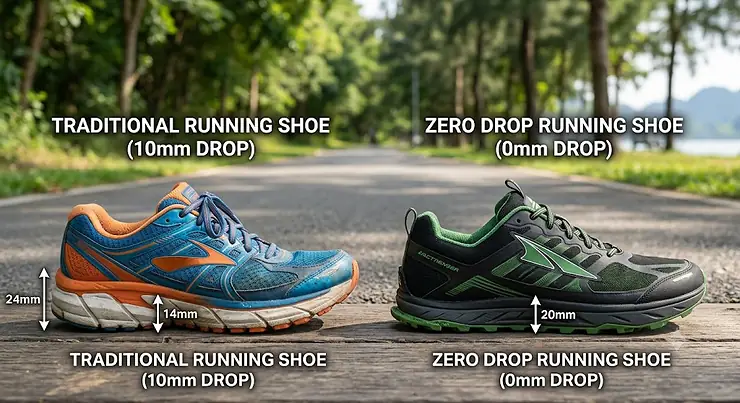
]Your feet were doing just fine for a few hundred thousand years before anyone strapped a wedge of foam under your heel. That’s the whole pitch behind zero drop running shoes for men — shoes where your heel and forefoot sit at exactly the same height off the ground, instead of the 8-12mm ramp built into most daily trainers. A zero drop running shoe is defined by having 0mm of heel-to-toe drop, meaning the sole is level from back to front, which encourages a more natural foot strike and posture instead of the forward tilt a raised heel creates. That’s it. No gimmicks, no marketing fluff, just geometry.

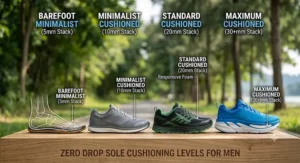
But “flat” doesn’t mean “identical.” Some zero drop shoes are barely-there minimalist slippers with 5mm of sole; others pack 30mm of plush foam under a level platform. We dug through real product specs, verified customer feedback, and peer-reviewed research on how zero-drop footwear changes lower-body biomechanics over time to help you sort budget picks from serious daily trainers. Whether you’re chasing your first pair of zero drop road shoes men actually recommend for beginners, or you’ve been running flat for years and want to upgrade, here’s what’s genuinely worth your money in 2026.
Quick Comparison Table
| Shoe | Stack Height | Weight (M9) | Price Range | Best For |
|---|---|---|---|---|
| WHITIN Wide Toe Box Zero Drop | ~12mm | ~8 oz | Under $60 | Testing zero drop on a budget |
| Topo Athletic ST-5 | 14mm | 6.6 oz | $110-$120 range | Lightest true minimalist road shoe |
| Xero Shoes HFS II | 9mm | 8.3 oz | $115-$125 range | Beginners easing into the category |
| Altra Escalante 4 | 24mm | 9.5 oz | $100-$130 range | Everyday versatile daily trainer |
| Merrell Trail Glove 7 | 14mm | 8.46 oz | $120-$145 range | Road-to-trail crossover runs |
| Altra Torin 8 | 30mm | 10.15 oz | $140-$160 range | Maximum cushion at zero drop |
| Vivobarefoot Primus Lite IV | ~8mm | ~8.3 oz | $160-$180 range | Purest barefoot feel for training |
Look at the stack height column and you’ll notice these seven shoes span a genuinely wide range — from the Vivobarefoot Primus Lite IV‘s razor-thin sole to the Altra Torin 8‘s nearly triple-digit cushioning. That’s the trap most buyers fall into: assuming “zero drop” and “minimalist” are the same thing. Based on the spec comparison, a heel-striker transitioning for the first time is much better served starting with something like the Altra Escalante 4 or Merrell Trail Glove 7 than jumping straight to the Topo Athletic ST-5‘s 14mm platform. Price doesn’t track neatly with performance here either — the budget WHITIN option genuinely delivers the core zero drop experience, just with less refined materials than the premium names.
💬 Found a shoe here that fits your stride? Tap the link and see current pricing before your size sells out.
Top 7 Zero Drop Running Shoes for Men: Expert Analysis
We picked these seven to cover the real range of what “zero drop” means in practice: dirt-cheap entry points, do-everything daily trainers, and purist barefoot designs. Every one of these is a real, currently sold product — no filler picks.
1. WHITIN Wide Toe Box Zero Drop — best budget entry point
The standout here is simple: you get a genuine zero drop, wide-toe-box shoe for roughly a third of what the big minimalist brands charge. Specs-wise, it runs a moderate stack height with a removable insole, so you can drop even lower to the ground once your feet adapt, and an EVA midsole that provides just enough underfoot cushioning to survive daily wear without feeling mushy. Who should care: budget-conscious runners and anyone who wants to “try before they buy” into the zero drop philosophy without committing $130+ upfront. What most buyers overlook about this model is that the wide toe box alone — letting your toes actually spread rather than getting pinched into a narrow triangle — solves half the discomfort people blame on “bad running shoes” in the first place. Reviewers consistently report that the shoe feels surprisingly roomy compared to mainstream running shoes, with several noting it rivals pricier wide-toe-box competitors, though a recurring theme in aggregated feedback is that sizing runs generous and buyers recommend going down half a size.
Pros:
- ✅ Wide toe box rivals shoes costing three times as much
- ✅ Removable insole lets you dial in your own ground feel
- ✅ Genuinely affordable way to test zero drop before investing more
Cons:
- ❌ Reviewers note the outsole wears down faster under heavy weekly mileage
- ❌ Thin midsole offers little forgiveness for committed heel strikers
At under $60, this is one of the only ways to sample true zero drop geometry without a serious financial commitment — just don’t expect it to survive marathon training blocks the way a $150 shoe would.
2. Topo Athletic ST-5 — lightest true minimalist road shoe
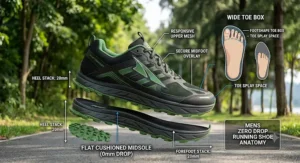
Topo shaved the ST-5’s stack height down to 14mm, and at 6.6 ounces it’s one of the lightest zero drop road shoes men can currently buy — light enough that you genuinely forget you’re wearing shoes on an easy run. The 14mm stack with a ZipFoam midsole means you get slightly more structure than a bare minimalist slipper, but the low-profile design still keeps you connected to the road surface, and the collapsible heel counter means it packs flat for travel. This is built for runners who already have some zero drop mileage under their belt, gym-goers who want one shoe for lifting and running, and anyone chasing a racing-flat feel without paying racing-flat prices. Based on the spec comparison, the ST-5 sits in an unusual middle ground: too minimal for total beginners, but far more cushioned and secure than a true barefoot shoe. Aggregated reviewer sentiment frames this as an excellent transitional shoe for someone who’s already comfortable in the Xero Shoes HFS II but wants slightly more support for tempo work.
Pros:
- ✅ Feather-light build at just 6.6 ounces per shoe
- ✅ Wide anatomical toe box paired with true minimalist geometry
- ✅ Collapsible heel counter is genuinely useful for packing and travel
Cons:
- ❌ 14mm stack offers minimal impact protection on hard pavement
- ❌ Reviewers say durability lags behind heavier-stack competitors at high mileage
3. Xero Shoes HFS II — best for beginners easing in
The HFS II’s standout feature is its 5,000-mile sole warranty, which is almost unheard of in the minimalist shoe world and speaks to genuine confidence in the outsole’s durability. Specs show a roughly 9mm stack height with a tire-tread-inspired rubber sole designed specifically for road grip in wet conditions, plus a wider foot-shaped toe box that’s become the brand’s signature. What most buyers overlook about this model is that “minimalist” doesn’t mean “unprotected” — the tread pattern is engineered for actual road traction, not just barefoot aesthetics. This shoe is for runners who want their first real zero drop experience without the ultra-thin sole of something like the Vivobarefoot line, and for anyone doing mixed road-and-gym training who values one durable, versatile pair. Reviewers consistently report the shoe feels close to barefoot while still offering meaningfully more protection from road debris than a true minimalist sandal-style shoe, and several note it’s noticeably grippier in rain than competitors in this price range.
Pros:
- ✅ 5,000-mile sole warranty is rare and reassuring for a minimalist shoe
- ✅ Tire-tread outsole grips wet roads better than most competitors
- ✅ Beginner-friendly stack height eases the barefoot transition
Cons:
- ❌ Minimal cushioning means road vibration is still noticeable on longer runs
- ❌ Narrower-footed runners report needing to size up half a size
4. Altra Escalante 4 — best everyday versatile daily trainer
The Escalante 4’s standout is its 24mm Altra EGO foam stack, which threads the needle between real cushioning and the ground-connected feel zero drop fans actually want. The FootShape toe box is Altra’s widest fit option, genuinely letting toes splay during push-off, and the InnerFlex midsole grooves keep the ride flexible despite the extra stack compared to true minimalist shoes. Who should care: runners who want one do-it-all shoe for daily miles, tempo work, and the occasional 10K, especially if they’ve already got some zero drop experience and want more cushioning without abandoning the flat platform. What the spec sheet won’t tell you, but reviewers note, is that the v4 fit runs noticeably narrower and lower-volume through the midfoot than earlier Escalante generations — a real consideration if you’ve owned a previous version and expect the same fit. Aggregated review sentiment is split along exactly this line: longtime Escalante fans with narrow feet love the new fit, while those with wider feet who loved the older, roomier versions have been more critical.
Pros:
- ✅ Roomy FootShape toe box lets toes splay naturally at push-off
- ✅ 24mm EGO foam balances real cushioning with ground feel
- ✅ Versatile enough to handle daily runs, speed work, and casual wear
Cons:
- ❌ Reviewers flag the v4 fit as narrower and lower-volume than past versions
- ❌ Flexible sole trades some structure for runners who want more lockdown
5. Merrell Trail Glove 7 — best road-to-trail crossover
The Trail Glove 7’s calling card is its Vibram EcoStep outsole, delivering serious grip whether you’re on wet pavement or a light dirt trail — a rare crossover trait in this category. At a 14mm stack height with zero drop and Merrell’s FloatPro foam midsole, it’s light enough for road miles but grippy and protective enough for trails with the occasional root or rock. This shoe is for runners who split their week between road and trail, gym-goers who want a barefoot-style shoe with genuine traction, and anyone who’s found pure road minimalist shoes too slick on wet mornings. Here’s what to weigh: the Vibram sole is a genuine performance upgrade over generic rubber outsoles, but a recurring theme in aggregated customer feedback is that the tread wears down faster than expected given the price point, particularly for runners logging trail miles on abrasive terrain. Reviewers who use it primarily for road walking and light trail running report high satisfaction with the zero-drop feel and grip, while those pushing it hard on technical trails see outsole wear sooner than they’d like.
Pros:
- ✅ Vibram EcoStep outsole grips wet pavement and light trail alike
- ✅ FloatPro foam adds just enough cushion without losing ground feel
- ✅ Doubles effectively as a gym shoe and everyday minimalist trainer
Cons:
- ❌ Reviewers consistently report the outsole tread wears faster than expected
- ❌ Better suited to mixed terrain than pure high-mileage road training
6. Altra Torin 8 — most cushioned zero drop option
The Torin 8’s headline number is its 30mm EGO MAX stack height — genuinely maximalist cushioning delivered on a completely flat, zero drop platform, which is a rarer combination than you’d think. The updated foam formula improves on the Torin 7’s energy return, and a new molded heel collar tightens up the fit that some past versions were criticized for. Who this is for: runners transitioning from thick, cushioned daily trainers who aren’t ready to give up plush cushioning but do want to eliminate the heel ramp, plus anyone logging high weekly mileage on hard pavement who needs more protection than a minimalist shoe provides. On paper this means you get Hoka-style cushioning without the forward-tilted posture — but reviewers are quick to note the tradeoff is weight, with the Torin 8 sitting noticeably heavier than most zero drop shoes and feeling stiffer underfoot than runners expect from a “natural” shoe. It’s best understood less as a minimalist shoe and more as a maximalist daily trainer that happens to be zero drop.
Pros:
- ✅ 30mm EGO MAX stack delivers real cushioning at true zero drop
- ✅ Molded heel collar meaningfully improves lockdown versus Torin 7
- ✅ Strong bridge option for runners easing off traditional cushioned trainers
Cons:
- ❌ At over 10 ounces, it’s heavier than nearly every other shoe on this list
- ❌ Reviewers note the platform feels stiffer than a “true” minimalist ride
7. Vivobarefoot Primus Lite IV — premium barefoot feel for urban training
The Primus Lite IV’s defining trait is its 2mm sole — about as close to actually barefoot as a shoe gets while still protecting your feet from glass and gravel. At roughly 235 grams per shoe, it’s remarkably light, built from recycled and vegan materials, and designed as a true all-rounder for lifting, walking, and easy running rather than a dedicated road racer. This is the shoe for barefoot purists, urban runners who want one shoe for commuting and gym sessions, and anyone who’s outgrown thicker “zero drop” shoes and wants to feel the actual ground. Reviewers consistently describe an almost startling lack of weight straight out of the box, and praise the wide toe box for genuine stability during lifting and lateral movement. The honest tradeoff, and one aggregated feedback returns to repeatedly, is durability: the thin mesh upper shows wear faster on abrasive surfaces than sturdier competitors, and the minimal sole means this isn’t the shoe for long trail days on rocky ground.
Pros:
- ✅ Ultra-thin 2mm sole gives the closest-to-barefoot feel on this list
- ✅ Exceptionally light at roughly 235 grams per shoe
- ✅ Recycled, vegan construction appeals to sustainability-minded runners
Cons:
- ❌ Reviewers report the mesh upper wears down quickly on abrasive terrain
- ❌ Premium price point for a shoe with almost no protective cushioning
Top 7 Products at a Glance
| Shoe | Stack Height | Drop | Cushion Level | Price Range |
|---|---|---|---|---|
| WHITIN Wide Toe Box Zero Drop | ~12mm | 0mm | Minimal | Under $60 |
| Topo Athletic ST-5 | 14mm | 0mm | Minimal | $110-$120 range |
| Xero Shoes HFS II | 9mm | 0mm | Minimal | $115-$125 range |
| Altra Escalante 4 | 24mm | 0mm | Mid | $100-$130 range |
| Merrell Trail Glove 7 | 14mm | 0mm | Minimal | $120-$145 range |
| Altra Torin 8 | 30mm | 0mm | High | $140-$160 range |
| Vivobarefoot Primus Lite IV | ~8mm | 0mm | Minimal | $160-$180 range |
Sorting by stack height rather than price tells the real story: the Altra Torin 8 and Altra Escalante 4 are cushioned daily trainers that happen to be zero drop, while the Vivobarefoot Primus Lite IV, Xero Shoes HFS II, and Topo Athletic ST-5 are genuinely minimalist shoes built for ground feel. If your Achilles and calves haven’t adapted to a flat platform yet, the higher-stack options in this table are the safer starting point, regardless of price.
Your First 30 Days in Zero Drop Shoes: Practical Usage Guide
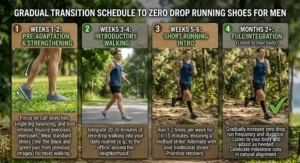
Switching into zero drop running shoes for men isn’t a swap-and-go situation — your calves and Achilles tendon have been getting a mechanical assist from that raised heel for years, and removing it changes the workload overnight. Start with walking mileage in your new shoes for the first week before running a single step; this lets your foot and ankle get used to the flat platform without the impact loading of running. Week two, alternate zero drop and your old cushioned shoes every other run, capping zero drop runs at 15-20 minutes. By week three, most runners can extend zero drop runs to 30-40 minutes if there’s no sharp pain, only the expected mild calf tightness. The most common first-month mistake is doing too much too soon — jumping straight into a 10K in a brand-new pair of zero drop shoes is asking for Achilles tendon strain, since flatter shoes shift meaningfully more load onto the ankle and Achilles tendon compared to a traditional 10-12mm drop trainer (more on the research behind this in the heel-toe differential section below). Add two sets of standing calf raises, three times a week, focusing on a slow eccentric lowering phase — this is the single best thing you can do to build tendon resilience before increasing zero drop mileage. Sharp, localized pain (as opposed to general muscle fatigue) is your body telling you to back off, not push through.
Real-World Scenarios: Which Zero Drop Shoe Fits Your Life
The gym commuter. You lift three times a week and want one shoe that works for squats, deadlifts, and the occasional treadmill run home from the office. A wide, stable platform matters more than road cushioning here — the Vivobarefoot Primus Lite IV or Xero Shoes HFS II both give you a flat, stable base for lifting without needing a second pair of shoes.
The marathon-in-training convert. You’ve been running 30+ miles a week in traditional cushioned trainers for years and want to slowly introduce zero drop without derailing your training block. Don’t switch your whole rotation at once — bring in the Altra Torin 8 as a Tuesday easy-run shoe first, since its 30mm stack still gives you real cushioning while removing the heel ramp, and keep your traditional shoes for long runs until your Achilles adapts.
The budget-first beginner. You’ve read about zero drop shoes and want to try the category before spending real money. The WHITIN Wide Toe Box Zero Drop gets you into a genuine zero drop shoe for well under $100, letting you test whether the flat platform even agrees with your stride before committing to a $150 pair.
How to Choose Zero Drop Running Shoes for Men
Picking the right zero drop shoe comes down to a handful of factors that matter far more than brand name:
- Check the stack height, not just the drop. Two shoes can both be “zero drop” while one has 8mm of cushioning and another has 30mm — decide how much protection you actually want underfoot.
- Match cushioning to your running background. Heel strikers coming from traditional trainers should start with higher-stack zero drop shoes like the Altra Torin 8, not ultra-minimal designs.
- Prioritize toe box width. A genuinely wide, foot-shaped toe box is often more important for comfort than the drop itself, since it lets your toes function naturally during push-off.
- Consider your surface. Road-only runners want a smooth, road-specific outsole, while anyone mixing in trails benefits from a grippier sole like the Merrell Trail Glove 7‘s Vibram unit.
- Factor in your calf and Achilles strength. If you have a history of Achilles tightness or tendinopathy, ease in gradually and consider a higher-stack option first, regardless of what looks “cooler.”
- Set a realistic budget. The WHITIN Wide Toe Box Zero Drop proves you don’t need to spend $150 to try the category, though premium builds like the Vivobarefoot Primus Lite IV do use better materials.
- Read aggregated reviews for durability, not just comfort. Several shoes on this list get glowing initial-comfort reviews but mixed longevity feedback — check both.
Zero Drop vs Low Drop Running Shoes Men Actually Debate
This is one of the most common points of confusion in the category, and it matters for anyone comparing zero drop road shoes men against the increasingly popular 4mm “low drop” alternatives. Zero drop means exactly 0mm difference between heel and forefoot height — your foot sits perfectly level. Low drop typically refers to shoes in the 2-4mm range, still dramatically flatter than a traditional 8-12mm trainer but with a small heel elevation retained.
| Factor | Zero Drop (0mm) | Low Drop (2-4mm) |
|---|---|---|
| Achilles/calf demand | Highest | Moderate |
| Posture correction | Most dramatic | Noticeable but gentler |
| Transition difficulty | Steepest learning curve | Easier for beginners |
| Best For | Experienced minimalist runners | Runners easing away from traditional shoes |
The analysis here matters more than the number suggests: biomechanical research comparing different heel-to-toe drops has found that shoes without any drop tend to increase ankle and foot injury rates while reducing knee injury rates, compared to shoes with a 10mm drop. In practice, that means the “zero vs low drop” debate isn’t really about which is objectively better — it’s about which joints you’re willing to load more heavily. Runners with a history of knee pain often do well moving toward zero drop, while runners with Achilles or calf issues sometimes find a low-drop shoe a gentler middle ground before going fully flat.
📉 Not sure if zero drop or low drop fits your stride? See today’s picks and compare specs side by side.
Common Mistakes When Buying Zero Drop Running Shoes for Men
The single biggest mistake is buying based on stack height alone and assuming “thinner equals more authentic.” A beginner grabbing the Vivobarefoot Primus Lite IV as their very first zero drop shoe is setting themselves up for calf soreness that has nothing to do with shoe quality and everything to do with going from 0 to 100 overnight. The second common error is ignoring toe box width entirely — a narrow zero drop shoe defeats half the purpose, since natural toe splay is a core part of why these shoes feel different in the first place. Third, runners frequently skip the walking-first adaptation period covered above, assuming that because the shoe feels comfortable standing in a store, it’ll feel the same after five miles of pavement pounding. Fourth, plenty of buyers ignore surface matching, buying a smooth road-focused sole like the Topo Athletic ST-5 for trail use and then blaming the shoe for poor grip. Finally, don’t buy your usual size on faith — reviewers across multiple brands in this category note sizing runs differently than mainstream running shoes, sometimes half a size small, sometimes generously large.
Zero Drop Running Shoes for Beginners
If this is your first pair, the goal isn’t to find the most minimal shoe on the market — it’s to find the shoe that lets you experience the flat platform without overwhelming your calves and Achilles tendon in week one. Beginners consistently do better starting with moderate-stack options like the Altra Escalante 4 or the higher-cushion Altra Torin 8, both of which deliver the postural benefits of zero drop while still cushioning the impact your body isn’t yet conditioned to absorb without a heel ramp. Ultra-minimal shoes like the Vivobarefoot Primus Lite IV or Xero Shoes HFS II are excellent second or third pairs once your feet and lower legs have built strength, but jumping straight there is the most common reason first-time zero drop runners quit the category within a month. A realistic beginner plan: pick a moderate-stack shoe, follow the 30-day adaptation guide above, and only consider a more minimal shoe once you can comfortably run 30-40 minutes without unusual soreness the next day.
Heel-Toe Differential Explained
Heel-toe differential — sometimes called drop, heel drop, or offset — is simply the difference in millimeters between how high the heel sits off the ground versus how high the forefoot sits. A shoe with 30mm of stack under the heel and 20mm under the forefoot has a 10mm drop; a shoe with 24mm under both is zero drop, regardless of how much total cushioning it has. This single number is arguably the most misunderstood spec in running shoes, because people frequently confuse it with total stack height or overall cushioning level, when it’s really just describing the geometry of the platform. Biomechanical research on heel-to-toe differential shows that a larger drop tends to reduce load on the ankle, Achilles tendon, and calf muscles while shifting more stress toward the knee, whereas a flatter drop reverses that pattern — which is why the “right” differential genuinely depends on your injury history rather than any universal rule. Traditional running shoes generally sit at 8-12mm, low-drop options run 2-4mm, and true zero drop shoes — every shoe reviewed in this article — sit at exactly 0mm.
Forefoot Loading and Achilles Tendon Adaptation
Removing the heel ramp doesn’t just change your posture — it changes which part of your foot hits the ground first and how much work your Achilles tendon has to do on every single stride. Zero drop shoes tend to encourage a shift toward midfoot or forefoot loading rather than a hard heel strike, largely because there’s no elevated heel to land on first. research on foot strike patterns and injury rates has found that the absence of a sharp impact peak in ground reaction force during a forefoot strike may contribute to lower injury rates among habitual forefoot strikers, compared to committed heel strikers — but the same body of research is clear that forcing this transition too quickly, rather than developing it gradually, is where injuries happen. What most buyers overlook about this shift is that your Achilles tendon and calf complex genuinely need to get stronger to handle it; this isn’t a psychological adjustment, it’s a physical adaptation that takes weeks of progressive loading, not days. The practical upshot: don’t chase forefoot striking as a deliberate technique change on day one. Let the zero drop platform encourage the shift naturally while you build tendon capacity with the calf-strengthening routine covered earlier, and expect real adaptation to take four to eight weeks of consistent, gradual mileage.
Features That Actually Matter (And Those That Don’t)
Marketing copy loves to talk about “barefoot connection” and “natural movement,” but a few specs actually predict how a shoe performs, and several popular ones don’t matter nearly as much as brands suggest. Stack height matters enormously — it’s the single best predictor of how much impact protection you’ll get, full stop. Toe box width matters just as much, since a narrow “zero drop” shoe undercuts the entire point of the design. Outsole rubber compound matters for durability and wet-weather grip, which is why the Merrell Trail Glove 7‘s Vibram sole earns real praise despite wearing down faster than some buyers expect. What matters far less: exact weight differences of half an ounce between competing shoes, which reviewers rarely notice in actual use, and flashy colorways or “energy return” percentages that sound impressive on a spec sheet but translate to negligible real-world difference at these stack heights. Research measuring impact accelerations across foot strike patterns has found meaningful differences in how loads are distributed through the leg, reinforcing that geometry and stack height — not marketing language — are what actually change your running experience.
Long-Term Cost & Maintenance
Zero drop running shoes for men typically last 300-500 miles before the midsole compresses and loses its structure, similar to traditional running shoes, though minimalist designs with thinner outsoles like the Xero Shoes HFS II and Topo Athletic ST-5 can sometimes stretch further since there’s simply less foam to break down. Total cost of ownership favors budget options like the WHITIN Wide Toe Box Zero Drop for casual runners logging under 15 miles a week, since replacing a $50 pair twice a year still costs less than one premium pair. For higher-mileage runners, the math flips: a durable option like the Altra Torin 8 or Merrell Trail Glove 7, run into the ground over 400+ miles, often delivers better cost-per-mile than cycling through cheaper shoes that wear out faster under heavy training loads. Rotating two pairs — one higher-stack option for long runs, one minimal shoe for easy days — is a smart way to extend the lifespan of both while giving your feet varied loading patterns.
Frequently Asked Questions
❓ Are zero drop running shoes good for beginners?
❓ What's the difference between zero drop and minimalist shoes?
❓ How long does it take to adapt to zero drop shoes?
❓ Can zero drop shoes cause Achilles tendonitis?
❓ What stack height should a beginner start with?
Conclusion
Zero drop running shoes for men aren’t a single category so much as a spectrum — from the razor-thin Vivobarefoot Primus Lite IV all the way to the plush 30mm Altra Torin 8, every shoe on this list shares the same flat platform but delivers a completely different ride. If you’re brand new to the category, resist the urge to buy the most minimal shoe you can find; start with more cushioning, respect your Achilles tendon’s adaptation timeline, and let your stride change gradually rather than forcing it. If you’ve already got zero drop miles under your belt, the Merrell Trail Glove 7 and Topo Athletic ST-5 are worth a look for anyone wanting to go flatter or more trail-capable. Whichever you choose, the shoe matters less than the transition plan — give your calves and tendons the weeks they need, and the natural, ground-connected feel these shoes offer becomes genuinely enjoyable instead of something you’re recovering from.
✨ Ready to make the switch? Check today’s prices on our top picks before you head out for your next run! 👟
Recommended for You
- Minimalist Running Shoes for Men: 7 Proven Picks (2026)
- Max Cushion Shoes Men Long Distance: 7 Picks That Survive 50 Miles
- Best Cushioned Running Shoes Men Knee Pain: 7 Top Picks (2026)
Disclaimer: This article contains affiliate links. As an Amazon Associate, I earn from qualifying purchases. If you purchase products through these links, we may earn a small commission at no additional cost to you.
✨ Found this helpful? Share it with your friends! 💬🤗
