
In This Article
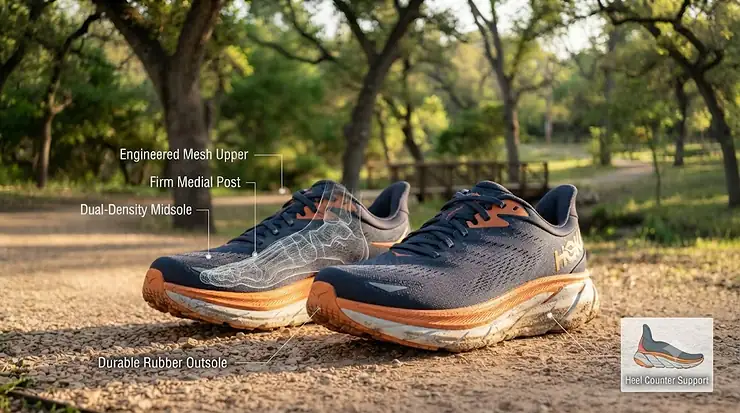
Stability running shoes for men are road running shoes built with extra structure — firmer foam, a wider base, or guided geometry — that gently keep your foot from rolling too far inward (overpronating) as you run. That’s the textbook definition, but here’s the part most buying guides skip: the category looks almost nothing like it did five years ago.

If your last pair of “support shoes” felt like strapping a plank to your foot, you’re judging 2026 by 2016 standards. 🏃♂️ The medial post — that hard wedge of foam under the arch — has quietly disappeared from almost every flagship model this year. Brands are now using wider platforms, dual-density foam, and guided sidewalls instead, which means modern stability daily trainer men’s shoes feel a lot closer to a cushioned neutral shoe than a corrective device.
That shift matters because a lot of guys avoid this category entirely, assuming it means stiff, heavy, “orthopedic” shoes. Some still are. But the seven shoes below represent where the category actually stands right now: tested, currently sold, and genuinely comfortable enough to wear every day, not just when your knee is complaining. We dug into lab measurements, long-term wear reports, and real owner feedback to build this list, and we’ll walk through who each shoe actually fits — not just what’s printed on the box.
Quick Comparison: Best Stability Running Shoes for Men at a Glance
| Shoe | Stability Tech | Stack Height (Heel/Forefoot) | Weight (Men’s 9) | Best For |
|---|---|---|---|---|
| Brooks Adrenaline GTS 25 | GuideRails | 36–37mm / 26–27mm | ~10.6 oz | All-around daily trainer |
| ASICS GEL-Kayano 33 | FluidSupport | 39–40mm / 31–32mm | ~10.5 oz | Max-cushion long runs |
| HOKA Arahi 8 | H-Frame | 39–41mm / 33mm | ~9.3 oz | Lightweight, mild support |
| New Balance 860v15 | Stability Plane | 40–43mm / 34–35mm | ~11.8–12.1 oz | Wide feet, plantar fasciitis |
| Saucony Guide 19 | CenterPath | 35mm / 29mm | ~9.7 oz | Budget daily trainer |
| HOKA Gaviota 6 | H-Frame (max) | 38–39mm / 32–33mm | ~10–10.25 oz | Severe overpronation |
| ASICS GT-2000 14 | 3D Guidance | 35.5–36.5mm / 27.5–28.5mm | ~9.5–9.6 oz | Lighter, racier support |
A few patterns jump out once you line these up side by side. The Saucony Guide 19 and ASICS GT-2000 14 sit at the lower end of both price and stack height — they’re the value daily trainer men’s options here, trading some plushness for a lighter, snappier feel. On the opposite end, the New Balance 860v15 and HOKA Gaviota 6 lean into maximalist stacks for runners who want a more deliberate, planted ride. The Brooks and the Arahi land in the comfortable middle, which is exactly why they’re so popular as everyday picks.
💬 Just one click — help others make better buying decisions too!😊
💬 Found a pair you’re already eyeing?
Click through to check current pricing and availability before they restock!😊
Top 7 Stability Running Shoes for Men: Expert Analysis
1. Brooks Adrenaline GTS 25 — The Reliable All-Rounder
The Brooks Adrenaline GTS 25 is the shoe most podiatrists default to recommending, and after 25 versions, that’s not an accident. The GuideRails system — firmer foam strips along the medial and lateral edges of the midsole — only engages when your knee or ankle drifts outside its normal range, rather than fighting your stride the entire time you run. In practice, that means you get a noticeably calmer landing without the “locked into a brace” feeling older stability shoes were known for.
What most buyers overlook here is the heel geometry change from the previous version: Brooks dropped the offset to 10mm and added extra foam in the forefoot, which smooths out the transition for heel strikers specifically. If you tend to land hard on your heel during long runs, that’s the detail that actually changes how your shins feel the next morning — not the GuideRails marketing copy.
Customer feedback: Owners consistently praise the secure midfoot lockdown and describe the support as “there when you need it” rather than constant. The most common complaint is added heel-collar bulk that runs slightly warm in summer.
✅ Pros:
- Smooth, adaptive GuideRails support
- Comfortable for both running and all-day standing
- Wide range of widths available
❌ Cons:
- Heavier than several competitors on this list
- Less responsive than newer super-foam stability shoes
Use-case match: Best for runners who want one dependable shoe for daily mileage, recovery jogs, and the occasional long walk without switching pairs.
Price & value: Typically in the $140-$160 range. Given the durability and brand track record, it’s one of the safer first purchases if you’ve never tried a stability shoe before.
2. ASICS GEL-Kayano 33 — Maximum Cushion for Long Miles
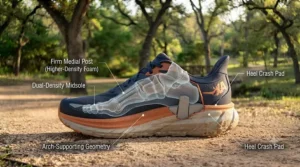
The ASICS GEL-Kayano 33 marks the biggest shake-up in the franchise’s recent history: the long-running 4D Guidance pod is gone, replaced by a new dual-layer foam setup ASICS calls FluidSupport. Instead of an active support piece pushing back against pronation, the shoe leans on geometry — a dual-density midsole and broader base — to keep your stride centered.
In plain terms, this is a softer-landing, slower-feeling shoe that rewards patience. The FF Blast Max top layer cushions the first contact beautifully, while the firmer FF Blast Plus underneath stops that softness from collapsing into mush over a long run. The trade-off, and it’s worth saying clearly: if you relied on the old version’s more assertive medial post feel, this update is noticeably gentler, which matters for severe overpronators specifically.
Customer feedback: Long-time Kayano wearers are split — walkers and standing-all-day professionals tend to love the plush ride, while faster training runners miss the snappier heel transition of the prior generation.
✅ Pros:
- Excellent shock absorption on hard pavement
- Roomy fit available in standard, wide, and extra-wide
- APMA Seal of Acceptance for foot health
❌ Cons:
- Premium price tag
- Less energetic feel than competitors using PEBA-based foams
Use-case match: Ideal for marathon training, long recovery runs, or anyone on their feet for hours who needs cushioning over snap.
Price & value: Expect a $165-$180 range. It’s pricier than most on this list, but the cushioning longevity makes it a reasonable buy for high-mileage walkers and runners alike.
3. HOKA Arahi 8 — The Lightest Stability Shoe That Doesn’t Feel Like One
The HOKA Arahi 8 is the shoe to hand a skeptic who insists they “don’t need a stability shoe because they’re all clunky.” HOKA swapped the old J-Frame (medial-only support) for a new H-Frame design that wraps both sides of the midfoot, and the result feels less like correction and more like a gentle cradle.
What that means for you on the run: the H-Frame only really announces itself when your foot starts to drift, not on every single step. Combined with HOKA’s signature Meta-Rocker geometry, the Arahi 8 rolls you forward through the gait cycle instead of just absorbing impact and stopping there. The catch most reviewers flag is the heel transition — it can feel slightly abrupt on the very first few runs before the dual-density EVA softens up.
Customer feedback: Reviewers frequently describe this as the stability shoe they’d recommend to someone who’s “never worn one before,” thanks to the unusually light feel for the support category.
✅ Pros:
- Among the lightest stability daily trainer men’s shoes available
- Wide, accommodating toe box
- Smooth rocker geometry for effortless transitions
❌ Cons:
- Mild stability only — not enough for severe overpronation
- Outsole durability lags behind the cushioning’s lifespan
Use-case match: Great for runners who need gentle guidance, not aggressive correction, and who prioritize a light, easy-mile feel.
Price & value: Usually listed in the $145-$160 range — solid value for the weight savings alone.
4. New Balance Fresh Foam X 860v15 — Built for Wide Feet and Plantar Fasciitis
The New Balance 860v15 went bigger in almost every direction this year. Stack height jumped substantially over the v14, and New Balance refined its Stability Plane — a nylon plate sandwiched between two foam densities that runs the length of the shoe — rather than relying on the old-school medial post.
Here’s the practical takeaway: that plate creates a noticeably wider, more “sat-down” platform feel, which is exactly why podiatrists often steer patients with flat arches or plantar fasciitis toward this model specifically. The trade-off for all that structure is weight — this is one of the heaviest shoes on this list — but New Balance offsets it somewhat with a true-to-size fit that comes in narrow, standard, wide, and extra-wide options, which is rare in this category.
Customer feedback: Wide-footed runners and all-day-on-your-feet workers (nurses, retail staff) consistently call this their most comfortable stability option, while faster runners note it feels sluggish for anything above an easy pace.
✅ Pros:
- Broadest width range of any shoe on this list
- High stack offers excellent impact protection
- Smooth, gentle guidance rather than harsh correction
❌ Cons:
- Heaviest shoe in this roundup
- Not suited to tempo work or faster training
Use-case match: Best for wider feet, varus heel/forefoot conditions, or anyone whose podiatrist specifically recommended extra medial support.
Price & value: Around the $145-$160 range, which is competitive given the width options most competitors don’t offer.
5. Saucony Guide 19 — The Budget-Friendly Daily Trainer
The Saucony Guide 19 proves you don’t need a triple-digit price increase to get real stability tech. Saucony’s CenterPath system skips a medial post entirely, instead using a wider midsole base and raised sidewalls to passively guide your foot — no firm wedge pressing into your arch at all.
The detail that actually matters here: Saucony also reformulated the PWRRUN foam this year, giving it noticeably more bounce than the outgoing version while keeping the price lower than most rivals. That’s an unusual combination — brands typically raise prices when they upgrade foam. The trade-off is a real one, though: at this stack height, the Guide 19 offers gentler guidance than the Kayano or Gaviota, so severe overpronators may find it too subtle.
Customer feedback: Owners frequently call this their go-to recovery and easy-mile shoe, praising the wide toe box, though several note the shoe runs heavier than its weight on paper suggests once it’s actually laced up.
✅ Pros:
- Lowest price point among true stability daily trainers
- Wide platform and roomy toe box
- Noticeably improved outsole durability over prior versions
❌ Cons:
- Mild support — not enough for moderate-to-severe overpronation
- Less exciting ride for faster sessions
Use-case match: Perfect first stability shoe for budget-conscious runners with mild pronation issues, or as a dedicated easy-day pair.
Price & value: Generally under $145, making it the strongest value pick on this entire list.
6. HOKA Gaviota 6 — Maximum Support for Severe Overpronators
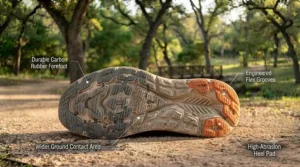
If the Arahi 8 is HOKA’s whisper of stability, the HOKA Gaviota 6 is the shout. This is the brand’s high-support model, using a beefed-up version of the H-Frame that runs the full length of the shoe rather than just through the midfoot, paired with HOKA’s tallest stack height in this lineup.
The real story this year is the weight cut — HOKA trimmed roughly half an ounce off the previous version while keeping the maximal stack, which is a meaningfully different feel underfoot. What most buyers won’t realize until they’ve logged a few runs: the firmer H-Frame foam needs roughly 10-15 miles to break in before the ride smooths out. Try them on cold in a store and they can feel almost stiff; that’s not the shoe failing, that’s just unbroken-in compression-molded EVA doing its job.
Customer feedback: Reviewers with flat feet or significant overpronation routinely call this their most secure-feeling daily shoe, while neutral runners testing it out of curiosity often find it more structure than they personally need.
✅ Pros:
- Strongest, most full-length stability on this list
- Surprisingly light for a maximal-support shoe
- Improved outsole traction over the prior generation
❌ Cons:
- Premium pricing
- Firm out-of-box feel until broken in
Use-case match: Built for runners with flat feet, significant overpronation, or anyone whose current shoes are wearing out unevenly on the inner edge.
Price & value: Typically in the $175-$190 range — a real investment, but it’s purpose-built for exactly the runner who needs this level of structure.
7.ASICS GT-2000 14 — Lightweight Support With a Bit of Speed
The ASICS GT-2000 14 is what happens when ASICS asks, “what if our budget stability shoe could also feel a little fun?” This year’s redesign dropped the brand’s 3D Guidance System into a noticeably lighter, lower-stack chassis than the Kayano, borrowing the bouncy FF Blast Max foam from the Novablast line.
The practical effect: this shoe achieves stability through shoe shape and foam placement rather than a hard medial post, so it never feels like it’s correcting you — it just quietly keeps your platform wider and more centered. That same foam also makes it noticeably more capable of handling tempo runs than most shoes in this category, which is unusual for something at this price point.
Customer feedback: Owners frequently mention being surprised by how “normal” this shoe feels for a support model, with several calling it a more affordable, lighter alternative to the Kayano specifically.
✅ Pros:
- Lighter and more responsive than most stability shoes
- Strong value at this price tier
- APMA Seal of Acceptance
❌ Cons:
- Less plush than max-stack options like the 860v15 or Gaviota
- Warmer upper due to the supportive mesh construction
Use-case match: Great for runners who want moderate support but refuse to give up a livelier, faster-feeling ride.
Price & value: Usually found in the $130-$145 range, putting it neck-and-neck with the Guide 19 as a top budget pick.
How to Choose Stability Running Shoes for Men in 7 Steps
Picking the right shoe from a list is easier once you know what you’re actually solving for. Here’s the order we’d walk through it in a shop:
- Confirm you actually overpronate. Check the wear pattern on your current shoes’ soles — heavy wear on the inner edge of the heel is the classic sign. A running store gait analysis is more reliable than guessing.
- Decide your support level. Mild drift toward the arch favors the Arahi 8 or Guide 19; flat feet or significant rolling point toward the 860v15 or Gaviota 6.
- Match stack height to your mileage. Higher stacks (Kayano, 860v15, Gaviota) protect better on long runs; lower stacks (GT-2000 14, Guide 19) feel quicker for shorter, faster efforts.
- Check width availability. If you have wide feet, prioritize brands offering 2E/4E options — New Balance and ASICS lead here.
- Consider your primary use. Daily training, walking, and standing all day favor plusher, heavier shoes; mixed training with some speed work favors the lighter picks.
- Set a realistic budget. You can get genuinely effective support technology for under $145 — paying more buys cushioning volume and width options, not necessarily “more stability.”
- Try before fully committing if you can. Stability tech feels different on every foot; what reads great on a spec sheet can still feel wrong on your specific arch.
Real-World Scenarios: Which Stability Shoe Fits Your Running Life
The marathon-training commuter: If you’re logging 40+ weekly miles and standing on your feet at work between runs, the cushioning volume of the New Balance 860v15 or ASICS GEL-Kayano 33 matters more than weight. Both protect joints over high mileage, and the wide availability of widths in the 860v15 specifically helps if your feet swell on longer efforts.
The “I just started running and my shins hurt” beginner: Start with something forgiving rather than aggressive. The Brooks Adrenaline GTS 25 or Saucony Guide 19 offer genuine support without the steep break-in period or higher price tag of the maximal options — a smart way to test whether stability shoes actually help before investing more.
The weekend warrior chasing a faster 10K: If you need support but refuse to feel like you’re running in bricks, the ASICS GT-2000 14 and HOKA Arahi 8 both lean lighter and livelier, letting you hold pace during tempo work while still getting guided support on tired late-run strides.
The flat-footed standing-all-day professional: Nurses, teachers, and retail workers who also run benefit most from the HOKA Gaviota 6 — full-length stability designed for exactly this combination of standing fatigue and structured movement.
Problem → Solution: Fixing the Most Common Stability-Shoe Complaints
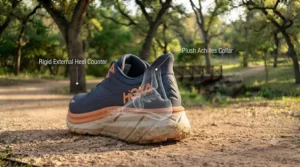
Problem: “My current stability shoe feels stiff and overcorrective.” Newer geometry-based systems — GuideRails, H-Frame, CenterPath — replace old rigid medial posts. Switching from an older medial-post shoe to something like the Arahi 8 or Guide 19 often resolves this complaint entirely.
Problem: “I get knee pain on longer runs even in a support shoe.” This is often a stack-height issue rather than a stability-tech issue. Moving to a higher-stack option like the 860v15 or Kayano 33 adds protective cushioning volume that a lower-stack shoe simply doesn’t have, regardless of how good its guidance system is.
Problem: “My shoes wear out unevenly within a few months.” Uneven wear on the inner heel edge, even in a stability shoe, often means you need a firmer, more structured option than what you’re currently in. The Gaviota 6’s full-length H-Frame specifically targets this pattern.
Problem: “Stability shoes always feel too narrow for my feet.” Look specifically at brands offering wide and extra-wide sizing — the New Balance 860v15 and ASICS lineup both offer broader width ranges than most competitors.
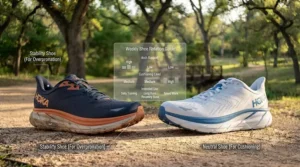
Stability vs. Neutral Running Shoes: What’s Actually Different in 2026
| Category | Neutral Shoes | Stability Shoes |
|---|---|---|
| Who they’re for | Efficient, aligned natural stride | Moderate-to-severe overpronation |
| How support works | None built in | Geometry, dual-density foam, or guided sidewalls |
| Feel | Lets the foot move freely | Gentle guidance, not rigid correction |
| Risk if mismatched | Fine for most runners | Can push a neutral foot outward, causing new issues |
The line between these two categories has genuinely blurred this year — as you can see in our in-depth coverage of stability technology, nearly every flagship stability shoe in 2026 dropped the traditional medial post in favor of geometric guidance. That’s good news if you’ve avoided the category because of stiffness in the past, but it also means the “is this really a stability shoe” question is murkier than it used to be. The short version: if your current shoes wear unevenly or your podiatrist has flagged overpronation, a stability shoe is still the right call — it just won’t feel like the boxy shoes from a decade ago.
Common Mistakes Men Make When Buying Stability Running Shoes
- Assuming heavier always means more supportive. Weight and support level aren’t the same axis — the GT-2000 14 is lighter than the Adrenaline GTS 25 but offers comparable guidance for milder overpronation.
- Buying based on a past version’s reputation. Several shoes on this list changed their core stability tech entirely in the latest release (Kayano’s FluidSupport, Arahi’s H-Frame). If you loved an older version, don’t assume the current one feels the same underfoot.
- Ignoring width entirely. A correctly supportive shoe in the wrong width can still cause blisters and discomfort that gets blamed on “the stability tech” instead of the fit.
- Skipping the break-in period before judging. Firmer support systems like the Gaviota’s H-Frame genuinely soften with miles. Writing off a shoe after one short run can mean missing out on how it actually performs once broken in.
Features That Actually Matter (And the Marketing Hype That Doesn’t)
What matters: stack height relative to your mileage, width availability, and whether the American Podiatric Medical Association has reviewed the model for foot health — several shoes on this list, including the GT-2000 14 and Kayano 33, carry that recognition.
What matters less than it sounds: branded technology names. GuideRails, H-Frame, CenterPath, FluidSupport, and Stability Plane are five different marketing terms for variations on the same basic idea — using firmer foam or wider geometry to slow pronation without a rigid post. None of them is objectively “the best” system; what matters is how much guidance your specific foot needs, not which buzzword sounds more advanced.
Long-Term Cost and Maintenance
Most running shoes, stability or otherwise, hold up for roughly 300-500 miles before the midsole foam compresses past the point of useful support — even if the outsole tread still looks fine. That’s worth tracking, because foam breakdown happens before visible wear, which means a shoe can look “good for more miles” and still be quietly failing to protect your joints. If you’re logging 20 weekly miles, that puts you on a replacement cycle of roughly every four to six months.
Budget picks like the Saucony Guide 19 and ASICS GT-2000 14 lower the cost-per-mile math significantly if you’re rotating shoes every season anyway. Premium options like the Kayano 33 or Gaviota 6 make more financial sense if you log enough mileage to actually wear through the more durable outsole compounds before the foam gives out — otherwise you’re paying for durability you won’t use up.
FAQ: Stability Running Shoes for Men
❓ Do I actually need stability running shoes if I overpronate mildly?
❓ How long do stability running shoes for men typically last?
❓ Are stability running shoes good for walking and standing all day?
❓ Can a stability shoe be bad for a neutral runner?
❓ What's the difference between mild and moderate stability running shoes?
Conclusion: Finding Your Best Stability Running Shoes for Men
The biggest shift in stability running shoes for men this year isn’t any single piece of technology — it’s that the category finally stopped feeling like a compromise. Whether you land on the all-around dependability of the Brooks Adrenaline GTS 25, the featherweight guidance of the HOKA Arahi 8, or the no-compromise structure of the Gaviota 6, every shoe on this list proves you don’t have to trade comfort for support anymore.
If you’re still unsure, start with your wear pattern and your wallet: budget and mild support points toward the Saucony Guide 19 or ASICS GT-2000 14, while significant overpronation and a bigger budget points toward the Gaviota 6 or Kayano 33. Everyone else probably lands comfortably in the middle with the Brooks, the Arahi, or the New Balance.
✨ Don’t Miss These Exclusive Deals!
🔍 Take your running game to the next level with these carefully selected stability shoes. Click on any highlighted pair to check current pricing and availability. The right pair makes every training mile feel a little easier!
Recommended for You
- 7 Best Men’s Neutral Shoes for Half Marathon in 2026
- Neutral Running Shoes for Men Under $150: 7 Best Picks for 2026
- 7 Best Neutral Running Shoes for Men With High Arches (2026)
Disclaimer: This article contains affiliate links. As an Amazon Associate, I earn from qualifying purchases. If you purchase products through these links, we may earn a small commission at no additional cost to you.
✨ Found this helpful? Share it with your friends! 💬🤗
