
In This Article
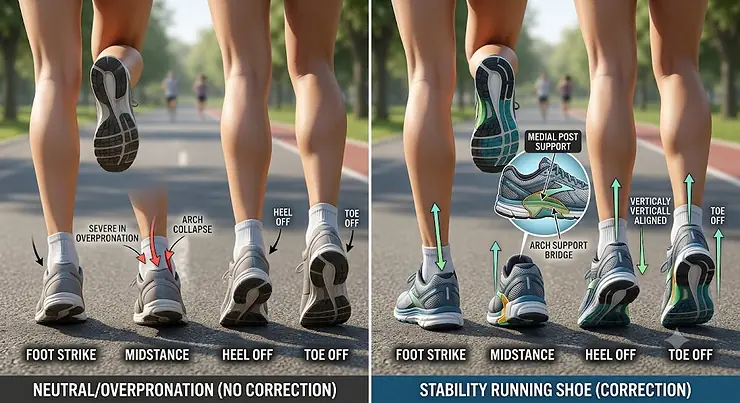
Your ankle rolls in a little on every stride. You’ve noticed the inside edge of your old sneakers wearing down faster than the rest. Maybe a physical therapist mentioned the word “overpronation” during your last visit for shin splints. If any of that sounds familiar, you’re not imagining things, and you’re definitely not alone — stability running shoes for women exist precisely because women’s feet, hips, and stride mechanics don’t move through space exactly like men’s do. A stability running shoe is a trainer built with extra structural guidance — through a medial post, a firmer foam density, or an external “rail” system — that gently limits how far your foot rolls inward after it lands, so your joints absorb shock the way they’re supposed to instead of twisting under the load.
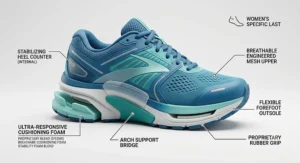
The tricky part is that “stability” isn’t one single design anymore. Walk into any running store and you’ll find postless guide rails sitting next to dense foam plates sitting next to zero-drop platforms that claim to fix pronation by not elevating the heel at all. That variety is good news for your feet, but it makes shopping genuinely confusing if you don’t know what you’re looking at. This guide breaks down seven real, currently available shoes — from budget-conscious daily trainers to plush premium options — with honest analysis of what each one’s engineering actually does for your stride, backed by real spec sheets and aggregated reviewer sentiment rather than marketing copy. According to the APMA Seal of Acceptance program, footwear submitted for review is evaluated by a panel of podiatrists specifically for whether it supports normal foot function — several of the shoes below carry that seal, which is a useful, medically grounded signal when you’re comparing stability trainer women’s models rather than relying on marketing claims alone.
By the end, you’ll know exactly which of these seven shoes fits your gait, your mileage, and your budget — plus how to actually evaluate arch support, medial posts, and “dynamic stability” claims the next time you’re standing in a shoe aisle feeling overwhelmed.
Quick Comparison Table: Stability Running Shoes for Women at a Glance
| Shoe | Stability Type | Drop | Price Range | Best For |
|---|---|---|---|---|
| ASICS GT-2000 13 | LiteTruss (light guidance) | 8mm | Around $140 | Budget-conscious daily runners |
| Brooks Adrenaline GTS 24 | GuideRails | 12mm | Around $140 | All-around overpronation support |
| Saucony Guide 17 | Center Path (postless) | 6mm | Around $140 | Runners who dislike firm medial posts |
| New Balance 860v14 | Dual-density medial post | 8mm | Around $140 | Traditional, proven pronation control |
| Hoka Arahi 7 | J-Frame | 5mm | $140-$150 range | Lightest true stability shoe |
| ASICS Gel-Kayano 32 | 4D Guidance System | 8mm | In the mid-$160s | Max-cushion premium daily trainer |
| Altra Paradigm 7 | GuideRail, zero-drop | 0mm | Around $170 | Natural gait, wide toe box |
Reading this table sideways for a second: the drop numbers alone tell an important story. Hoka Arahi 7 and Altra Paradigm 7 sit at the low end (5mm and 0mm), which shifts load toward your calves and Achilles rather than your knees — great if you’re chasing a more “natural” stride, but not something to jump into cold if you’ve run in 10-12mm shoes for years. The higher-drop options like Brooks Adrenaline GTS 24 are more forgiving for heel-strikers who aren’t ready to change their mechanics. Price-wise, none of these seven are wildly out of step with each other — the real differentiator is stability architecture, not cost.
💬 Just one click — help others make better buying decisions too!😊
Top 7 Stability Running Shoes for Women: Expert Analysis
1. ASICS GT-2000 13 — best value lightweight stability shoe
The ASICS GT-2000 13 is what happens when ASICS takes everything people love about the Gel-Kayano 32 and strips it down to something lighter and less expensive without abandoning the support. At 8.3 oz per shoe with an 8mm drop (35.5mm heel, 27.5mm forefoot), it uses ASICS’ LiteTruss system and 3D Guidance System rather than the Kayano’s denser guidance hardware, which in practice means you get meaningful pronation control without the “brick on your foot” feeling some max-stability shoes deliver. The FF BLAST PLUS midsole paired with rearfoot PureGEL cushioning means shock absorption doesn’t feel like an afterthought bolted onto a stability chassis — it’s genuinely comfortable underfoot on easy and moderate-paced runs alike.
Reviewers consistently describe the GT-2000 13 as reliable rather than exciting, and that’s honestly the point — this is a shoe built to disappear under your feet run after run rather than draw attention to itself, which is exactly what you want in a daily trainer. It’s the shoe to reach for if you’re newer to stability shoes, training on a budget, or just tired of shoes that overcorrect your stride. Runners managing mild-to-moderate overpronation who don’t want maximum cushioning tend to get along with this shoe best, while people chasing plush, max-stack comfort should look further down this list.
Pros:
- ✅ Noticeably lighter than the flagship Kayano at a similar support level
- ✅ Multiple width options (standard, wide, extra-wide) fit more foot shapes
- ✅ Lower price point than premium stability trainers
Cons:
- ❌ Less cushioning depth than the Kayano for very long runs
- ❌ Feels like a middle-ground shoe if you want maximum plushness or maximum correction
Priced around $140, the ASICS GT-2000 13 delivers strong value for runners who want dependable guidance without paying premium-trainer prices.

2. Brooks Adrenaline GTS 24 — most trusted GuideRails all-arounder
The Brooks Adrenaline GTS 24 has been the default recommendation from run-specialty staff for over two decades, and the 24th version earns that reputation with a nitrogen-infused DNA Loft v3 midsole that’s noticeably softer than its predecessors while keeping the GuideRails holistic support system intact. Rather than a rigid medial post under your arch, GuideRails work at the edges of the midsole, only engaging when your knee or ankle drifts outside its normal path of motion — which means neutral-leaning runners can wear this shoe on lower-support days without feeling boxed in. At 8 oz with a 39/27mm stack and a 12mm drop, it sits on the higher-drop end of this list, which suits heel-strikers who prefer a traditional ride over a low-to-the-ground feel.
What most buyers overlook about the Adrenaline is that its stability strategy has fundamentally changed over the years — Brooks dropped the dense medial post that used to define this shoe in favor of the guide rail approach years ago, and the GTS 24 continues refining that philosophy with a wider, more accommodating toe box than previous versions. Reviewers frequently note the smoother heel-to-toe transition compared to older Adrenaline models, though a recurring theme in aggregated feedback is that the upper runs a bit low-volume and can be tricky to lock down for wider feet. This is the shoe for runners who want dependable guidance for daily mileage without experimenting with newer, less-proven stability technology.
Pros:
- ✅ Smooth, well-cushioned ride from nitrogen-infused DNA Loft v3 foam
- ✅ GuideRails accommodate both overpronators and near-neutral runners
- ✅ Wide toe box improvement over earlier Adrenaline generations
Cons:
- ❌ Low-volume upper can feel tight for wider feet
- ❌ Heavier than its stack height would suggest
At around $140, the Brooks Adrenaline GTS 24 remains the safest, most broadly recommended pick on this list for runners who just want a shoe that works.
3. Saucony Guide 17 — postless stability that still guides your stride
The Saucony Guide 17 represents the biggest philosophical shift on this list — Saucony scrapped the traditional medial post entirely in favor of what it calls Center Path Technology, a combination of a broader platform, higher sidewalls, and an asymmetric midsole shape that guides your foot down a center line without ever feeling like a hard wedge under your arch. At just 8.1 oz with a lowered 6mm drop, it’s also one of the lightest stability shoes in this roundup, which matters if you’ve felt fatigued by the heft of traditional posted trainers on longer runs.
Here’s what the spec sheet won’t tell you outright: dropping the drop from 8mm (Guide 16) to 6mm, combined with a rocker-shaped midsole, changes how the shoe transitions you from heel to toe, and reviewers report the ride feels noticeably smoother and less clunky than previous Guide generations as a result. The PWRRUN midsole with a PWRRUN+ sockliner adds a plusher step-in feel than you’d expect from a stability shoe this light. Runners who’ve been burned by stiff, rigid medial-post shoes in the past are the ideal audience here — this shoe proves stability doesn’t have to mean stiffness. Runners who specifically want the reassurance of a firm, traditional post underfoot might find the postless approach feels too subtle.
Pros:
- ✅ Lightest true stability shoe in this list at 8.1 oz
- ✅ No rigid medial post — support without stiffness
- ✅ Plush PWRRUN+ sockliner improves step-in comfort
Cons:
- ❌ Newer stability approach with less multi-year track record than posted designs
- ❌ Some overpronators may want firmer, more traditional correction
At a price around $140, the Saucony Guide 17 is the shoe to try if you want stability engineering that’s evolved past the classic post.
4. New Balance Fresh Foam X 860v14 — classic dual-density medial post, rebuilt
If you’re the kind of runner who specifically wants a traditional medial post rather than a rail or frame system, the New Balance Fresh Foam X 860v14 is the most straightforward option here. It pairs a dual-density Fresh Foam X midsole with a new EVA Film Stability Plane — essentially a lightweight plate sandwiched between softer top foam and a firmer base layer, positioned exactly where a classic medial post would sit. The result, at an 8mm drop with a 38/30mm stack, is a shoe that feels stable specifically because of density contrast rather than added weight or bulk.
Based on the spec comparison with its own predecessor, the 860v14 added stack height while somehow coming in lighter than the v13, and reviewers frequently point to the wider base as the reason the ride feels planted even on tired-legs long runs. This is also one of the few shoes on this list explicitly HSA/FSA-eligible when used to manage a diagnosed foot condition, and it carries the APMA Seal of Acceptance. What most buyers overlook is that New Balance’s stability lineup has two tiers — the 860 for moderate control and the Vongo for maximal correction — so if the 860v14 still feels like too much shoe, that’s a sign to look toward lighter guide-rail options like the Guide 17 instead. Runners managing moderate-to-higher overpronation who’ve relied on medial posts for years will feel instantly at home here.
Pros:
- ✅ Traditional dual-density medial post proven over 14 generations
- ✅ APMA Seal of Acceptance and HSA/FSA eligibility
- ✅ Wider platform improves stability without added stiffness
Cons:
- ❌ Slightly aggressive stability feel for truly neutral runners
- ❌ Weight sits on the higher end for its stack height
Priced around $140, the New Balance 860v14 is the go-to if proven medial-post engineering matters more to you than newer guide-rail trends.
5. Hoka Arahi 7 — lightest low-drop stability shoe for daily miles
The Hoka Arahi 7 takes a genuinely different approach to correction with its J-Frame technology — a J-shaped sweep of firmer foam running along the medial side of the heel and arch that guides your foot without the intrusive feel of a hard post. Combined with a low 5mm drop and a featherweight 8.1-8.3 oz build, it’s easily the lightest true stability shoe in this roundup, and the compression-molded EVA midsole leans firmer than the plush foams found in the Kayano or 860v14.
What the spec sheet doesn’t fully capture is how the Arahi 7’s rigidity actually functions as a stability feature in itself — independent lab testing rated its torsional stiffness among the highest of any moderate-stability shoe tested, which helps keep the foot aligned through transitions even without heavy midsole hardware. Reviewers describe the fit as true to size with a newly redesigned flat-knit upper that some longtime Arahi wearers find narrower than before. The lower 5mm drop shifts more load to your calves and Achilles, so this shoe rewards runners with strong lower-leg conditioning or those specifically trying to transition toward a more natural stride. If you mostly run 90 minutes or less and want the lightest possible stability shoe, this is your pick; if you’re logging marathon-length long runs, the firmer ride may feel less forgiving by mile 18.
Pros:
- ✅ Lightest genuine stability shoe on this list at roughly 8.1 oz
- ✅ Low 5mm drop encourages a more natural stride pattern
- ✅ APMA Seal of Acceptance for foot health
Cons:
- ❌ Firmer ride than plush competitors like the Kayano
- ❌ Best suited to runs under about 90 minutes rather than max long-run mileage
At around $145, the Hoka Arahi 7 is ideal for runners who want stability engineering without carrying extra ounces.
6. ASICS Gel-Kayano 32 — premium max-cushion trainer with adaptive stability
The ASICS Gel-Kayano 32 is the shoe most run-specialty staff still reach for first when a customer says “I need serious support but I also want it to feel plush.” This 32nd generation marks the first time the Kayano line has dropped to an 8mm heel-to-toe offset (down from the traditional 9-10mm), a change made possible by adding 2mm of forefoot foam and reshaping the rearfoot geometry so the heel compresses more on landing. At a 40mm heel and 32mm forefoot stack, it’s the tallest, most cushioned shoe on this list, yet it retains the APMA Seal of Acceptance and a genuinely wide base that keeps it feeling planted rather than wobbly despite all that foam.
Based on lab measurements from independent reviewers, the Kayano 32 tested stiffer than its predecessor in bend testing — a deliberate design choice, since a stiffer platform under a tall stack helps keep the foot tracking straight during the gait cycle rather than tipping. Aggregated reviewer sentiment consistently highlights the smoothest heel transition of any Kayano generation tested, alongside a secure, true-to-size upper. The recurring complaint across sources is that the ride is firmer than expected for a shoe with this much stack height, and it remains among the heavier options here. This is the shoe for runners logging serious weekly mileage who’ve decided comfort and correction shouldn’t be a trade-off — budget-focused shoppers or runners who prefer a lighter, more responsive feel should look toward the GT-2000 13 or Arahi 7 instead.
Pros:
- ✅ Tallest, most cushioned stack on this list without feeling unstable
- ✅ Improved heel transition versus previous Kayano generations
- ✅ APMA Seal of Acceptance for foot health
Cons:
- ❌ Firmer underfoot feel than the plush stack height suggests
- ❌ Still on the heavier side compared to lighter stability options
In the mid-$160s, the ASICS Gel-Kayano 32 is the premium pick for runners who want maximum cushioning without sacrificing correction.
7. Altra Paradigm 7 — zero-drop alternative for a more natural gait
The Altra Paradigm 7 takes the boldest approach on this list: instead of elevating your heel and using foam density to control pronation, it keeps your foot completely level at a true zero-drop platform and pairs that with a GuideRail system for medial support only when you need it. At 30mm of EGO MAX foam under both heel and forefoot, plus Altra’s signature foot-shaped toe box, this shoe asks a genuinely different question than the other six — what if pronation control started with letting your foot move the way it was built to, rather than correcting it after the fact?
Here’s what buyers considering their first zero-drop shoe should weigh carefully: reviewers who tested the Paradigm 7 alongside more traditional stability shoes note it delivers a comfortable, stable ride for neutral runners and mild overpronators alike, but anyone accustomed to a 10-12mm drop shoe should transition gradually rather than switching cold, since the shift in calf and Achilles loading can lead to soreness if you jump straight into long runs. The roomy anatomical toe box is the standout feature reviewers return to again and again — for women who feel cramped in traditional narrow toe boxes, the ability to let toes splay naturally is described as a genuine game-changer for balance, not just comfort. This shoe suits runners curious about barefoot-adjacent training who still want a structured, cushioned platform underneath them.
Pros:
- ✅ Roomy, foot-shaped toe box lets toes splay naturally for better balance
- ✅ Genuine zero-drop platform for a more natural gait pattern
- ✅ GuideRail support without a rigid medial post
Cons:
- ❌ Requires a gradual transition if you’re used to higher-drop shoes
- ❌ Priciest option on this list and not ideal for tempo-paced training
At around $170, the Altra Paradigm 7 is the shoe to consider if you want to address pronation by changing your foundation rather than correcting on top of it.
Practical Usage Guide: Breaking In and Maintaining Your Stability Trainers
Getting the most out of any pair on this list starts before your first run. Wear your new shoes around the house for a day or two first — this lets the upper flex naturally around your foot and helps you catch any hot spots before they become blisters on a 6-mile run. For the first 30 days, keep your mileage increases modest; even a shoe engineered specifically for your gait needs a break-in period where the midsole foam settles into its intended compression pattern, and jumping straight into your longest run of the month in brand-new shoes is one of the most common first-30-days mistakes.
If you’re switching from a higher-drop shoe to something like the Hoka Arahi 7 or the zero-drop Altra Paradigm 7, ease in with shorter, easy-paced runs for two to three weeks before returning to your normal long-run distance — your calves and Achilles need time to adapt to the new loading pattern. Rotate two pairs of running shoes if your budget allows; alternating shoes gives the midsole foam roughly 24 hours to fully rebound between runs, which measurably extends usable lifespan. Most stability trainers hold their supportive properties for 300-500 miles depending on your weight, stride, and running surface — track your mileage with an app rather than guessing, since visually a shoe can look fine while the internal foam has already lost most of its rebound. Finally, replace laces before they fray rather than after, and re-lace with a runner’s loop at the top eyelet if you notice heel slip, which is often mistaken for a fit problem when it’s really a lacing problem.
Real-World Scenarios: Which Stability Shoe Fits Your Life
Consider three different runners to see how this actually plays out. A marathon-training teacher in her 30s, logging 35-40 miles a week with a long run every Sunday, needs maximum cushioning that won’t break down under cumulative mileage — the ASICS Gel-Kayano 32 or New Balance 860v14 make the most sense here, since both prioritize durability and plush protection over speed. A busy new runner in her 20s doing three 3-mile runs a week on a tight budget wants dependable support without overpaying for race-day technology she won’t use yet — the ASICS GT-2000 13 hits that price-to-support ratio well.
A 45-year-old runner returning from a bout of plantar fasciitis, cleared by her physical therapist to resume easy mileage but told to prioritize natural foot mechanics, might be steered toward the Altra Paradigm 7‘s wide toe box and zero-drop platform specifically because it lets the smaller stabilizing muscles in her foot re-engage rather than outsourcing all the work to a rigid post. And a competitive recreational runner training for a fast half-marathon who still overpronates under fatigue in the later miles benefits from the Hoka Arahi 7 or Saucony Guide 17 — both deliver genuine stability at a weight that won’t slow her down on tempo days. None of these are the “objectively best” shoe; they’re the best shoe for that specific runner’s mileage, budget, and injury history.
Buyer’s Decision Framework
If you’re standing in a shoe store or scrolling a product page trying to decide, use this simple framework: if you’ve never worn a stability shoe before and don’t know your exact pronation severity, choose a moderate guide-rail shoe like the Brooks Adrenaline GTS 24 or ASICS GT-2000 13, because both accommodate a range of gait patterns without overcorrecting. If a podiatrist or physical therapist has specifically diagnosed moderate-to-severe overpronation, choose a shoe with a true medial post or dense stability plate like the New Balance 860v14 or ASICS Gel-Kayano 32, since these are engineered for more assertive correction. If you’re logging long mileage and comfort over 90+ minutes is your top priority, prioritize the tallest, most cushioned stack — that’s the Kayano 32 again. If weight and a natural stride matter more than maximum correction, choose the Hoka Arahi 7 for a low-drop option or the Altra Paradigm 7 for true zero-drop. And if budget is the deciding factor above all else, the ASICS GT-2000 13 delivers the strongest support-per-dollar on this list.
Understanding Your Women’s Gait Pattern
Every stability shoe in this guide exists because of measurable differences in how women’s bodies move through a running stride compared to men’s. A meta-analysis of sex-specific running biomechanics found that female runners consistently show more frontal and transverse plane motion in the lower extremities during running than male runners, including greater hip internal rotation, hip adduction, and peak knee abduction. That’s a clinical way of describing exactly the inward knee-and-ankle collapse that stability shoes are built to guide against — it isn’t a flaw in your form, it’s a consequence of anatomy, particularly a wider pelvis relative to femur length that changes the angle at which force travels down your leg.
Research specifically tracing the roots of women’s running shoe design found that women tend to pronate more than men at footstrike, largely because they produce a greater contact angle and have a larger Q angle — the angle formed between the hip and knee — a pattern first studied in depth decades ago and still the foundation of women’s-specific stability engineering today. This doesn’t mean every woman overpronates, or that every woman needs a stability shoe — plenty of women have neutral or even supinated gait patterns. But if you’ve noticed uneven wear on the inside edge of your soles, felt your ankle or knee ache after longer runs, or been told by a coach or gait-analysis session that you overpronate, that’s your body giving you exactly the signal these seven shoes are engineered to answer. For details on how sex differences show up across the whole kinetic chain, this systematic review and meta-analysis is a useful deeper resource if you want to understand the research behind the marketing.
Medial Support Post Explained: What It Actually Does
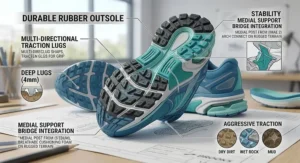
The term “medial support post” gets thrown around constantly in running shoe marketing, but it has a very specific, mechanical meaning. A medial post is a wedge of firmer-density foam placed along the inner (medial) edge of the midsole, usually under the arch and rearfoot. Because it’s denser than the surrounding foam, it compresses less when your foot rolls inward, which physically slows and limits the degree of pronation compared to running in a shoe with uniform-density foam throughout. The New Balance 860v14 uses this approach most literally, with a dual-density foam setup plus an EVA Film Stability Plane positioned right where a classic post would sit.
Here’s what most marketing pages leave out: not every “stability” shoe on this list actually uses a traditional post anymore. The Saucony Guide 17 dropped its post entirely for a wider base and asymmetric shape, while Brooks‘ GuideRails work at the outer edges of the midsole rather than under the arch, only firming up when your joint path drifts outside a normal range. Neither approach is objectively better — a traditional post delivers more assertive, constant correction, which suits higher-severity overpronators, while rail and frame systems engage more selectively, which many neutral-leaning runners find more comfortable over long mileage. Understanding which category a shoe falls into before you buy saves you from paying premium prices for correction you don’t actually need, or under-buying support for a gait pattern that genuinely requires it.
Dynamic Stability: The New Generation of Support
“Dynamic stability” is the phrase shoe brands increasingly use to describe support systems that respond to how your foot is actually moving in real time, rather than applying constant, uniform correction regardless of your stride. ASICS’ 4D Guidance System in the Gel-Kayano 32 and 3D Guidance System in the GT-2000 13 are built around this idea — the geometry of the midsole and outsole is shaped so support engages more as pronation increases, rather than a fixed post that behaves the same way whether you’re barely rolling in or rolling in significantly.
The practical upside of dynamic stability designs is that they tend to feel less restrictive for runners whose pronation severity varies by fatigue level, terrain, or pace — you get more correction exactly when you need it, on tired final miles, without the shoe feeling overbuilt on easy days. A biomechanical study cited in a clinical review of women-specific running shoe research also found that women exhibit a greater inversion rate and angle during resupination compared to men, which is part of why dynamic, responsive support systems have gained traction specifically in women’s stability lines — a rigid, one-size-fits-all correction doesn’t account for how much that inversion pattern can vary run to run. If you’ve tried traditional posted shoes and found them either too aggressive on easy days or not quite enough on tired days, a dynamic-stability shoe like the Kayano 32 or GT-2000 13 is worth testing.
How to Choose Stability Running Shoes for Women
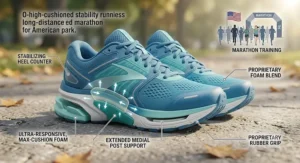
Picking the right pair comes down to working through a short list of decision points in order:
- Get your gait assessed first. Many run-specialty stores offer free treadmill gait analysis, and it’s the single most reliable way to confirm whether you actually overpronate and how severely, rather than guessing from shoe wear patterns alone.
- Match support level to severity. Mild overpronators generally do well in guide-rail shoes like the Brooks Adrenaline GTS 24; moderate-to-severe cases usually need a true medial post like the New Balance 860v14 or ASICS Gel-Kayano 32.
- Decide on drop before cushioning. A dramatic drop change (say, from 10mm to 0mm) affects your calves and Achilles more than any other single spec — choose gradually if you’re switching categories.
- Prioritize toe box shape for your foot. Wider forefoot shoes like the Altra Paradigm 7 reduce bunion and neuroma irritation that narrow toe boxes can aggravate over high mileage.
- Weigh cushioning against your typical run length. Long-run and marathon training favor taller stacks like the Kayano; shorter, faster sessions favor lighter shoes like the Hoka Arahi 7 or Saucony Guide 17.
- Test before you commit to a full mileage block. Run at least a few easy miles in-store or with a return-friendly retailer before racking up 20+ miles in a shoe you haven’t fully vetted.
- Budget for replacement, not just purchase. Stability shoes lose their functional support well before they look worn out, so factor a 300-500 mile replacement cycle into your annual running budget from day one.
Best Arch Support Running Shoes for Women: What Actually Matters
“Best arch support” is one of the most search-heavy phrases in this category, and it’s also one of the most misunderstood. Arch support in a running shoe isn’t a single rigid arm bar under your foot — it’s a combination of midsole density, sidewall height, and sockliner shape working together to prevent your arch from collapsing excessively during the stance phase of your stride. Shoes like the Saucony Guide 17, with its higher sidewalls and asymmetric platform, and the New Balance 860v14, with its dual-density foam directly under the arch, approach the same goal — limiting excessive arch collapse — through genuinely different structural methods.
What most buyers overlook is that a removable, aftermarket insole rarely fixes a genuine arch support deficiency in a shoe whose midsole geometry isn’t built for it — the midsole itself, not just the sockliner, is doing the structural work in a true stability shoe. If you have notably flat arches or a history of plantar fasciitis, the taller sidewalls and firmer arch-area foam in the Gel-Kayano 32 or 860v14 tend to deliver more consistent support through a full run than lighter, more flexible shoes. If your arches are only mildly low or you supplement with a custom orthotic already, a lighter guide-rail shoe with more sockliner room, like the Brooks Adrenaline GTS 24, may be the more comfortable long-term fit.
Common Mistakes When Buying a Stability Trainer Women Rely On
The most frequent mistake is buying based on a diagnosis you self-assigned from a YouTube video rather than an actual gait assessment — plenty of runners buy maximum-correction shoes for mild pronation and end up feeling like their foot is being forced into an unnatural path. The second common mistake is chasing a drop change too aggressively; runners who jump straight from a 12mm shoe into a zero-drop model like the Altra Paradigm 7 without a transition period frequently develop calf tightness or Achilles soreness within the first few weeks. A third mistake is buying stability shoes exclusively based on a partner’s or friend’s recommendation without accounting for your own gait pattern, arch height, or mileage goals — what stabilizes one runner’s stride can feel restrictive on a different foot shape entirely.
A fourth and surprisingly common mistake is ignoring width. Several shoes on this list, including the ASICS GT-2000 13 and Saucony Guide 17, come in multiple width options, yet many runners default to standard width even when their forefoot genuinely needs more room, which can create the sensation of instability that has nothing to do with the shoe’s actual stability engineering. Finally, holding onto a stability shoe well past its functional lifespan — often 300-500 miles — because it still looks intact is a mistake that quietly reintroduces the exact pronation problem the shoe was bought to solve in the first place.
Stability vs Neutral Running Shoes: Which Is Right for You
| Factor | Stability Shoes | Neutral Shoes |
|---|---|---|
| Best For | Overpronators, flat-to-low arches | Neutral or supinated gait patterns |
| Support Mechanism | Medial post, guide rails, or dense foam plate | Uniform-density foam throughout |
| Feel | Slightly firmer, more structured | Softer, more flexible underfoot |
| Example | New Balance 860v14, Brooks Adrenaline GTS 24 | Ghost-style daily trainers, most racing flats |
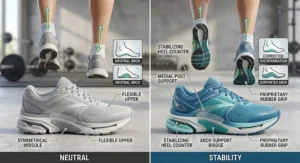
The core difference isn’t quality — it’s whether your foot needs structural guidance or not. Runners with a genuinely neutral gait who try a shoe like the Gel-Kayano 32 often describe it as feeling stiffer or more “locked in” than they’d prefer, since the correction they don’t need still shows up in the ride. Conversely, moderate-to-severe overpronators who train in neutral shoes frequently report accumulating knee or hip discomfort over higher mileage weeks, precisely because nothing in the shoe is limiting the inward roll that’s straining those joints. If you’re genuinely unsure which category fits, a professional gait assessment remains more reliable than guessing from either camp’s marketing claims.
✨ Don’t Miss These Exclusive Deals!
🔍 Take your stability running shoes for women search to the next level with these carefully selected picks. Click on any highlighted shoe to check current pricing and availability. These trainers will help you build the confident, injury-resistant stride every mile deserves!
Long-Term Cost & Maintenance of Women’s Stability Road Running Shoes
Thinking about stability shoes purely by sticker price misses the real cost-per-mile picture. A $140 pair of the ASICS GT-2000 13 replaced every 400 miles works out to roughly 35 cents per mile, while a $170 pair of the Altra Paradigm 7 — if its zero-drop platform genuinely reduces your injury frequency by improving natural foot strength — could easily save more in avoided physical therapy copays than the extra $30 up front. The real total cost of ownership for a stability shoe isn’t just the shoe itself; it’s the compounding cost of continuing to run in a worn-out or mismatched shoe, which is one of the most well-documented contributors to overuse injuries in distance runners.
Long-term durability also varies meaningfully by stability architecture. Dense medial-post foams, like the one in the New Balance 860v14, tend to hold their supportive shape slightly longer than guide-rail systems built into softer overall midsoles, simply because the correction is coming from a denser material that compresses more slowly over cumulative miles. That said, research on running-related injuries reinforces why paying attention to gait mechanics — not just shoe age — matters over the long run: one gait-biomechanics study found that runners with a history of a specific bone stress injury showed measurably higher rates of pronation at midstance and related coronal-plane movement patterns compared to injury-free runners, underscoring that shoe support is one part of a larger biomechanical picture rather than a total substitute for strength work and gait awareness (see the full gait-biomechanics research for the clinical detail). Budget for a replacement every four to six months if you’re running consistently, rotate two pairs to extend usable life, and treat the shoe as one input into your injury-prevention plan rather than the entire plan itself.
Frequently Asked Questions
❓ Do I actually need stability running shoes if I'm not sure I overpronate?
❓ How long do stability running shoes for women typically last?
❓ What's the difference between a medial post and GuideRails?
❓ Can a stability shoe fix overpronation permanently?
❓ Are zero-drop stability shoes like the Altra Paradigm 7 safe for overpronators?
Conclusion
Seven shoes, seven different engineering philosophies, and one shared goal: keeping your stride aligned so more of your training effort goes toward getting faster and stronger rather than managing joint strain. If you want the safest, most broadly recommended starting point, the Brooks Adrenaline GTS 24 or ASICS GT-2000 13 will serve the vast majority of runners well. If you’ve been specifically diagnosed with more significant overpronation, the New Balance 860v14 or ASICS Gel-Kayano 32 deliver more assertive, proven correction. And if you’re curious about a genuinely different approach to your gait rather than just correcting on top of it, the Hoka Arahi 7‘s low-drop lightness or the Altra Paradigm 7‘s zero-drop platform are worth a real test run.
None of this replaces a proper gait assessment if you’ve never had one, and none of it replaces paying attention to how your body actually feels a few miles into a new pair. But armed with real specs, real reviewer sentiment, and an honest breakdown of what each stability system is actually doing under your foot, you’re now equipped to make that choice with genuine confidence instead of guessing from a shelf display.
Recommended for You
- Neutral Running Shoes Women Under $130: 7 Picks for 2026
- 7 Best Neutral Running Shoes for Women Beginners (2026 Picks)
- 7 Best Neutral Running Shoes for Women with High Arches (2026)
Disclaimer: This article contains affiliate links. As an Amazon Associate, I earn from qualifying purchases. If you purchase products through these links, we may earn a small commission at no additional cost to you.
✨ Found this helpful? Share it with your friends! 💬🤗
