
In This Article
Here’s a number that surprises most runners: somewhere between one in five and nearly half of us — depending on which fit clinic you ask — are walking around on high arches without ever knowing it. You just think your feet are “fussy.” You blame the shoes. You blame the road. Really, you’ve got a rigid little arch that refuses to flatten on impact, and it’s been quietly steering every shoe decision you’ve ever made.
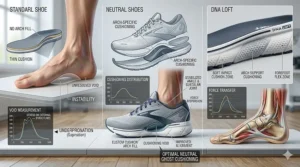
If you’re here, you’ve probably already noticed the pattern. Cushioned shoes feel better than firm ones. Stability shoes feel weirdly bossy, like they’re correcting a problem you don’t have. That’s not a coincidence — it’s biomechanics. High-arched feet under-pronate (the technical word is supinate), landing hard on the outer edge of the heel and never quite rolling inward to spread the load. Less natural shock absorption means the shoe has to pick up the slack.
The good news is that the answer isn’t exotic. It’s not some niche orthopedic shoe you’ll have to special-order. The best neutral running shoes for men with high arches are mostly the same plush, well-cushioned daily trainers everyone’s already running in — Brooks, ASICS, HOKA, New Balance, Nike, Saucony — just chosen with a specific eye toward stack height, drop, and toe-box room. Below are seven real, currently-available options, what they actually do for a high arch, and which one fits which kind of runner. No invented models, no fictional specs — just shoes you can check out on Amazon today.
Quick Comparison: 7 Neutral Shoes for High Arches at a Glance
| Shoe | Drop | Cushion Feel | Best For | Price Range |
|---|---|---|---|---|
| Brooks Ghost 17 | 10mm | Soft, balanced | All-around daily miles | $140–$150 |
| ASICS Gel-Nimbus 27 | 8mm | Max-plush | Heel strikers, long runs | $110–$165 |
| HOKA Clifton 10 | 8mm | Light, springy | Wide feet, recovery days | $145–$150 |
| New Balance Fresh Foam X 1080v15 | 6mm | Deep, protective | High-mileage comfort seekers | $165–$170 |
| ASICS Novablast 5 | 8mm | Bouncy, energetic | Tempo runs, faster training | $130–$150 |
| Nike Pegasus 42 | — | Responsive, snappy | Versatile training & racing tune-ups | $140–$145 |
| Saucony Triumph 23 | 10mm | Plush, smooth | Long, slow miles | $130–$170 |
A few things jump out once you line these up side by side. Notice that nobody on this list has a drop above 10mm — that’s not an accident, since high-arched feet that strike on the forefoot or midfoot generally do better with a lower heel-to-toe ramp. Notice, too, that price doesn’t track neatly with quality here: the Gel-Nimbus 27 is technically the most expensive shoe at full retail, but it’s also the one most frequently discounted on Amazon, so it can end up cheaper than the Pegasus depending on the week you buy. If you’re brand-loyal to ASICS, that’s worth knowing before you assume “premium” means “always pricier.”
Just one click — help others make better buying decisions too! 😊
✨ Found a favorite already?
Click through to check today’s price and color availability — one tap helps keep guides like this one free. 💬
The Top 7 Neutral Running Shoes for Men With High Arches in 2026
These aren’t ranked best-to-worst — they’re sorted roughly budget-to-premium, because the “best” one depends entirely on which kind of runner you are. Read the use-case line for each before you scroll to the price.
1. Brooks Ghost 17
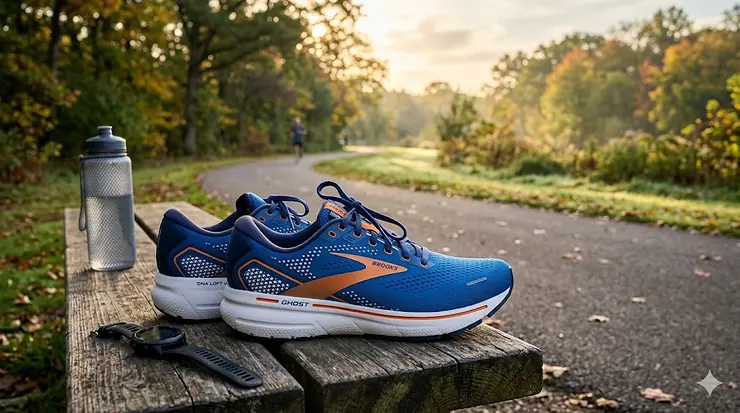
Brooks Ghost 17 is the shoe equivalent of a reliable friend who shows up on time, every time. Brooks shaved the heel-to-toe drop down from 12mm to 10mm this generation and added extra DNA Loft v3 foam — about 1mm more in the heel, 3mm more under the forefoot. In practice, that means less of a steep ramp pushing your weight backward into the heel, which matters for high-arched runners who tend to strike further forward than average.
What most buyers overlook about the Ghost is the toe box. It’s cut a touch roomier than Brooks’ race-day shoes specifically to accommodate the higher instep that often comes paired with a high arch — if you’ve ever felt squeezed across the top of your foot in other brands, this is where Brooks quietly fixed that. It also carries the APMA Seal of Acceptance, meaning a panel of podiatrists actually reviewed it for foot-health benefit rather than Brooks just slapping a sticker on the box.
✅ Smooth, predictable ride for easy and moderate-pace miles
✅ Roomy instep fits higher-volume feet without a break-in period
✅ Wide range of widths (narrow through extra-wide)
❌ Nothing flashy if you’re chasing a “bouncy” feel
❌ Slightly heavier than the more race-oriented shoes on this list
Who it’s for: the runner who wants one dependable shoe for three to five runs a week and doesn’t want to think about it again.
Price range: typically $140–$150 — genuinely solid value for a shoe built to last several hundred miles.
2. ASICS Gel-Nimbus 27
If the Ghost is the reliable friend, ASICS Gel-Nimbus 27 is the friend who insists on driving because their car has heated seats. This is ASICS’ max-cushion flagship, stacking 43.5mm of foam under the heel and 35.5mm under the forefoot — an 8mm drop — using FF Blast Plus Eco in the midsole with a pocket of PureGel tucked into the heel strike zone.
Here’s the part that actually matters for high arches: ASICS engineers this specific model around outer-heel strikers who need extra shock absorption, which is precisely the landing pattern that high-arched, supinating runners fall into. The toe box and midfoot are cut generously, too, so the higher instep that comes with a rigid arch doesn’t fight the upper. It’s also earned the APMA Seal of Acceptance for promoting foot health.
✅ The deepest, most protective cushioning on this list
✅ Roomy toe box accommodates higher insteps and toe splay
✅ Frequently discounted, so the “premium” shoe isn’t always the priciest
❌ At 10.7oz, it’s the heaviest shoe here — not built for speedwork
❌ The plush ride can feel a little disconnected if you’re used to firmer trainers
Who it’s for: anyone logging long, slow miles who wants the shoe to do most of the shock-absorbing work for them.
Price range: $165 at full retail, but it’s one of the most heavily discounted running shoes on Amazon — we’ve regularly seen it dip to $110–$130.
3. HOKA Clifton 10
HOKA Clifton 10 bumped its drop from 5mm to 8mm this generation, which is a bigger deal than it sounds. HOKA shoes have historically run very low-drop, which can feel unnatural to runners coming from traditional brands. Pulling the drop closer to “normal” while keeping the trademark thick CMEVA midsole gives you HOKA’s signature smooth, almost gliding transition without the adjustment period.
What most reviewers don’t mention: the Clifton 10 technically isn’t 100% neutral. It uses HOKA’s J-Frame technology — a firmer foam wrapped around part of the medial midsole — designed to gently discourage excessive inward roll without acting like a true stability shoe. For most high-arched runners (who under-pronate rather than over-pronate), this won’t feel like correction; it just adds a touch of underfoot stability on tired late-run strides. It also carries the APMA Seal of Acceptance.
✅ Wide, accommodating toe box — great for toe splay and wider feet
✅ Featherlight for how much cushion is underfoot
✅ Smooth, rocker-assisted transitions reduce midfoot strain
❌ The wide base means less “ground feel” if you want a connected ride
❌ Heavier than the previous Clifton generation due to the extra foam
Who it’s for: runners with wide or high-volume feet who want recovery-run comfort without sacrificing all responsiveness.
Price range: around $145–$150.
4. New Balance Fresh Foam X 1080v15
New Balance Fresh Foam X 1080v15 is New Balance’s “if we only made one shoe” flagship, and the midsole material is the headline here. Infinion foam replaces the older Fresh Foam X compound with something New Balance claims resists compression-related “dead leg” feeling over more miles — basically, the part of a shoe’s life where the foam packs down and stops springing back. With a 40mm heel stack and 34mm forefoot stack (a 6mm drop), it’s built to keep protecting your joints deep into a long run, which is exactly when high-arched feet — already poor natural shock absorbers — start to feel it most.
The redesigned perforated mesh upper is the other quiet win. It’s contoured rather than just stretchy, which gives a more structured hold around a higher instep instead of just ballooning out to fit.
✅ Genuinely plush even at mile 18, not just mile 1
✅ Reflective detailing if you run early or late
✅ Classic New Balance fit — true to size, no surprises
❌ The most expensive shoe on this list at full price
❌ The lower 6mm drop means less forgiveness for committed heel strikers
Who it’s for: the runner stacking serious weekly mileage who wants the cushioning to hold up at the end of the run, not just the start.
Price range: typically $165–$170.
5. ASICS Novablast 5
Where the Gel-Nimbus is plush and the Ghost is steady, ASICS Novablast 5 is the one that actually wants to go fast. FF Blast Max foam delivers a claimed 8.5% more energy return than the previous Novablast, paired with a “trampoline” outsole geometry designed to rebound rather than just absorb. The 41.5mm/33.5mm stack (8mm drop) keeps it cushioned enough for daily training while staying noticeably livelier underfoot than the other shoes here.
Here’s a detail worth knowing: Amazon’s own product page for this shoe specifically flags it as a fit for runners “whose feet strike the outer heel first, requiring more shock absorption” with a “high arches” foot type — which lines up exactly with classic supination mechanics. The midfoot is cut generously, too, so a higher instep won’t feel pinched mid-stride.
✅ Genuinely bouncy without feeling unstable
✅ Generous midfoot room for higher insteps
✅ Versatile enough for both easy days and pickup-the-pace tempo runs
❌ The energetic ride takes some adjusting if you’re used to dead-flat foam
❌ Less protective than the Gel-Nimbus on truly long efforts
Who it’s for: the high-arched runner who wants one shoe for both Tuesday’s easy jog and Thursday’s tempo session.
Price range: typically $130–$150.
6. Nike Pegasus 42
Nike Pegasus 42 marks the first time in the model’s four-decade history that it’s gotten a full-length Air Zoom unit instead of separate heel and forefoot pods, paired with ReactX foam that Nike claims is 13% more responsive than the previous React compound. Nike also widened the fit through the forefoot and toe box compared to the Pegasus 41, plus added more toe spring — the slight upward curve at the front of the shoe that helps your foot roll forward into the next stride instead of catching on the ground.
That widened forefoot is the detail that matters most here. High arches often come bundled with a tendency toward natural toe splay during push-off, and a toe box that’s too narrow will fight that motion mile after mile. The 42 finally gives that area some breathing room.
✅ More responsive feel than previous Pegasus generations
✅ Updated toe box accommodates natural toe splay
✅ Competitively priced for a major-brand daily trainer
❌ Runs slightly snug through the midfoot for very high-volume feet
❌ Less plush than the Nimbus or 1080 if max cushioning is your priority
Who it’s for: runners who want one shoe that can handle daily mileage and still hold its own on a race-pace workout.
Price range: $145, rarely discounted given its newness.
7. Saucony Triumph 23
Saucony Triumph 23 swapped in a softer, lighter version of Saucony’s PWRRUN PB foam this generation, paired with what the brand calls a “super-responsive sockliner” — essentially an extra-cushioned insole layer stacked on top of an already-plush midsole. At a 10mm drop (43mm heel, 33mm forefoot) and 8.8oz, it’s built specifically for the kind of slow, comfort-first long run where most of your mileage actually happens.
The detail that’s easy to miss: PWRRUN PB is a PEBA-based foam, the same general family of material used in racing super-shoes, just tuned softer here for durability rather than pure speed. That gives the Triumph a livelier underfoot feel than its plush-daily-trainer competitors, without sacrificing the deep cushioning a high arch needs to compensate for its own stiffness.
✅ One of the softest rides on this list without feeling mushy
✅ 10mm drop suits heel strikers especially well
✅ Available in a wide width for high-volume feet
❌ List price is the highest on this list before discounts
❌ The plush sockliner adds a touch of break-in “squish” some runners need a few runs to adjust to
Who it’s for: the high-mileage runner whose priority is comfort over speed on long, slow days.
Price range: $170 at list, but frequently marked down into the $130–$145 range.
| Shoe | Stack (Heel/Forefoot) | Weight (Men’s) | Midsole Foam | Best For |
|---|---|---|---|---|
| Brooks Ghost 17 | — | ~10.2oz | DNA Loft v3 | Everyday training |
| ASICS Gel-Nimbus 27 | 43.5mm / 35.5mm | 10.7oz | FF Blast Plus Eco + PureGel | Long, slow runs |
| HOKA Clifton 10 | — | ~9.8oz | CMEVA | Recovery, wide feet |
| NB Fresh Foam X 1080v15 | 40mm / 34mm | ~10.1oz | Infinion | High mileage |
| ASICS Novablast 5 | 41.5mm / 33.5mm | 9.0oz | FF Blast Max | Tempo & daily mix |
| Nike Pegasus 42 | — | 10.6oz | ReactX | Versatile training |
| Saucony Triumph 23 | 43mm / 33mm | 8.8oz | PWRRUN PB | Plush long runs |
Lined up this way, a pattern emerges: the lightest shoes (Novablast, Triumph) lean toward energetic or plush rides rather than maximum protection, while the heaviest (Gel-Nimbus, Pegasus) trade some weight for either deeper cushioning or a more structured upper. If you’re choosing between two shoes that look similar on paper, weight is usually the tiebreaker — lighter generally means livelier, heavier generally means more shock absorption banked into the foam.
Real Runners, Real Feet: Matching Shoes to Your Daily Miles
Specs only tell half the story — the other half is what your actual week looks like. A few scenarios make this easier than scrolling back up and cross-referencing a chart:
The desk-job commuter running 20–25 miles a week, mostly on tired legs after work: the Ghost 17 or Triumph 23 make more sense than anything bouncy. You don’t need energy return when your legs are already running on fumes — you need a shoe that absorbs the pounding for you.
The weekend long-run chaser building toward a half or full marathon: the Gel-Nimbus 27 or 1080v15 earn their keep here. Both are built to keep cushioning intact deep into a run, which is exactly when a high arch’s poor natural shock absorption starts to show up as soreness in the outer ankle and knee.
The runner who also wants speed days: the Novablast 5 or Pegasus 42 are the two shoes on this list flexible enough to handle an easy Tuesday and a tempo Thursday without feeling like the wrong tool for either job. Neither is a dedicated racing shoe, but both have enough pop to make a faster effort feel less like a slog.
When Your Feet Are Fighting You: Common High-Arch Problems and Shoe Fixes
A few complaints show up over and over in running forums and shoe reviews from high-arched runners. Here’s what’s usually going on, and which fix actually addresses it.
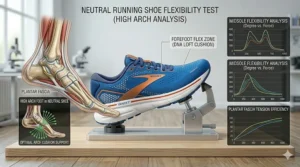
“My outer heel and ankle ache after long runs.” This is classic supination — your foot lands on the outside edge and never rolls in to spread the load. A shoe with a slightly lower drop (8mm or less) and generous heel cushioning, like the Gel-Nimbus 27 or Novablast 5, helps distribute that impact instead of concentrating it on one edge.
“My toes feel cramped no matter what I buy.” High arches often raise the instep, which paradoxically makes the whole shoe feel tight even if the length is right. Look for the roomier uppers here — the Ghost 17, Clifton 10, and Pegasus 42 are specifically cut wider through the forefoot and midfoot.
“I keep rolling my ankle.” That’s the structural downside of a rigid, high arch — less natural give means less built-in stability when the terrain gets uneven. A shoe with a slightly wider platform, like the Clifton 10’s J-Frame construction, offers a bit of unobtrusive support without becoming a full stability shoe.
“My shoes feel dead by month two.” That’s compression set — the foam has packed down. If you’re putting in serious mileage, the 1080v15’s Infinion foam and the Triumph 23’s PEBA-based PWRRUN PB are both built to resist that flattening longer than standard EVA compounds.
How to Choose Neutral Running Shoes for High Arches: 7 Things That Actually Matter
- Check the heel-to-toe drop first. Forefoot and midfoot strikers — common among high-arched runners — generally do better at 8mm or below. Confirmed heel strikers can comfortably go up to 10–12mm.
- Prioritize stack height over brand loyalty. More foam under the foot (generally 35mm+ at the heel) means more of the shock-absorbing work gets done by the shoe instead of your joints.
- Try the shoe on with your running socks, later in the day. Feet swell slightly through the day, and a shoe that fits at 8am can feel tight by 6pm.
- Pay attention to instep room, not just length. A high arch often means a taller foot, not just a longer one — a shoe can be the right size and still feel crushing across the top.
- Don’t assume “high arch” means “needs more support.” Most high-arched feet are already stiff and don’t pronate excessively; piling on stability features can make the ride feel restrictive rather than helpful.
- Look for the APMA Seal of Acceptance if you want a third-party check. It’s not a guarantee of perfect fit, but it does mean a panel of podiatrists reviewed the shoe for foot-health benefit.
- Buy two pairs if you find a fit you love. Brands discontinue and update models almost yearly — when you find the one that finally works, that’s the moment to stock up, not the moment to assume it’ll always be there.
Neutral vs. Stability Shoes: Why “More Support” Isn’t Always Better for High Arches
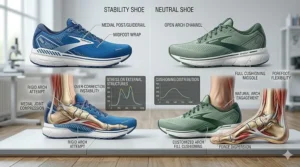
It’s a reasonable instinct: your feet feel unstable, so you reach for a “stability” shoe. According to the Cleveland Clinic’s overview of high arch feet, though, the instability most high-arched runners feel doesn’t come from over-pronation — it comes from the opposite problem, a foot that’s too rigid to roll inward and adapt to the ground at all. Stability shoes are engineered specifically to correct over-pronation. Pointing that correction at a foot that isn’t over-pronating can make the ride feel like it’s fighting your natural gait instead of helping it.
| Feature | Neutral Shoe | Stability Shoe |
|---|---|---|
| Arch support | None built-in | Medial post or guide rails |
| Base width | Standard to narrow | Wider, often flared |
| Best gait match | Neutral or under-pronation (supination) | Over-pronation |
| Heel counter | Softer, less rigid | Stiffer, more structured |
| Ride feel | Free-moving | Guided, corrective |
The takeaway from that table is straightforward: if you haven’t been specifically diagnosed with over-pronation by a gait analysis, default to neutral. Every shoe on this list fits that category — even the Clifton 10’s mild J-Frame stability is designed to work with a neutral gait, not override it. Save stability shoes for the rare case where a podiatrist or running-store gait analysis tells you it’s actually warranted.
Common Mistakes Men With High Arches Make When Buying Running Shoes
The biggest one, by a wide margin: buying based on a friend’s recommendation rather than your own foot’s needs. A buddy’s “best shoe ever” might be built around a completely different strike pattern and arch height than yours.
The second: ignoring drop entirely. A lot of runners shop by cushion level and brand name and never check the heel-to-toe drop number, which is one of the few specs that genuinely correlates with comfort for high arches specifically.
The third: assuming a higher price always means a better fit. The most expensive shoe on this list, the 1080v15, isn’t automatically the right choice for every high-arched runner — someone who strikes hard on the heel will likely get more out of the lower-drop Clifton or higher-stack Gel-Nimbus.
The fourth, and most common: buying a half-size too small because that’s “what I’ve always worn.” A higher instep paired with a too-snug length is a near-guaranteed recipe for black toenails on long runs.
What to Expect: How These Shoes Actually Feel on the Road
On paper, stack height and foam type are abstractions. On the road, here’s roughly what they translate to. The Gel-Nimbus 27 and 1080v15 feel like running on a slightly firmer mattress — protective, a little slower to respond, genuinely comfortable for hours. The Novablast 5 and Triumph 23 feel springier underfoot, more like the shoe is meeting your foot halfway rather than just cushioning the landing. The Pegasus 42 sits in between — responsive without tipping into “racing shoe” territory. The Ghost 17 and Clifton 10 are the most “forgettable” in the best sense: balanced enough that most runners stop noticing the shoe entirely after the first mile, which, for a daily trainer, is close to the highest compliment available.
Drop, Stack Height, and Why They Matter More Than the Spec Sheet Suggests
It’s tempting to treat drop and stack height as numbers to skim past on the way to the photos. For high arches, they’re closer to the whole story. According to Cleveland Clinic’s running shoe guide, heel-to-toe drop should generally match strike pattern — lower drop for forefoot and midfoot strikers, higher drop for committed heel strikers — and high-arched runners skew toward the forefoot/midfoot side of that split more often than the general population.
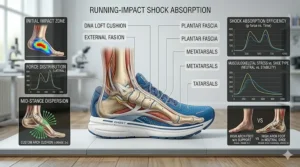
Stack height matters for a separate reason: a high, rigid arch absorbs noticeably less shock on its own than a flexible, neutral arch does, according to the American College of Foot and Ankle Surgeons’ overview of cavus foot. That gap has to get made up somewhere, and more foam under the foot is the most direct way a shoe can do it without resorting to corrective features you don’t actually need.
Long-Term Cost, Durability, and When to Replace Your Shoes
A $170 shoe that lasts 500 miles costs less per mile than a $90 shoe that’s dead at 250 — basic, but worth saying, because sticker shock on the 1080v15 or Triumph 23 makes sense in isolation and less sense once you do the math. As a rough rule, most daily trainers in this price tier hold meaningful cushioning for 300–500 miles, with foams like Infinion and PWRRUN PB skewing toward the higher end of that range based on their resistance to compression set.
The tell that it’s time to retire a pair isn’t always visible wear on the outsole — it’s often a flattened, dead feeling underfoot that shows up before the tread looks worn out. If you’re logging serious weekly mileage, rotating two pairs (even two of the same model) lets the foam in each fully decompress between runs, which can meaningfully extend the usable life of both.
Frequently Asked Questions
❓ What's the difference between neutral shoes for men with high arches and flat feet shoes?
❓ Do men's neutral running shoes with a wide toe box actually help high arches?
❓ What heel-to-toe drop is best for high arches?
❓ Are stability running shoes ever right for high arches?
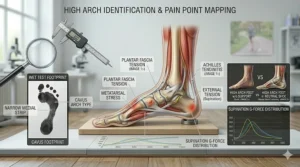
❓ How do I know if I have high arches without a gait lab?
Conclusion
There’s no single best neutral running shoe for high arches — there’s a best one for your weekly mileage, your strike pattern, and how much your feet swell by hour three of a long run. What all seven of these share is the same underlying logic: enough cushioning to compensate for what a rigid arch can’t absorb on its own, enough room through the instep and forefoot to stop fighting your foot’s actual shape, and a drop low enough to match how most high-arched runners actually strike the ground.
If you genuinely can’t decide, start with the Brooks Ghost 17 or ASICS Novablast 5 — both sit in the middle of this list on price, cushioning, and versatility, which makes them a safe first step before you know exactly which direction your preferences lean. From there, the only real test is time on the road. Specs get you close; a few easy miles tell you the rest.
✨ Don’t Miss These Exclusive Deals!
🔍 Take your next run to the next level with these carefully selected picks. Click through on any shoe above to check today’s price, colorway, and size availability before you commit. 👟
Recommended for You
- 7 Best Stability Running Shoes for Men With Overpronation (2026)
- 7 Best Stability Running Shoes for Men in 2026
- 7 Best Men’s Neutral Shoes for Half Marathon in 2026
Disclaimer: This article contains affiliate links. As an Amazon Associate, I earn from qualifying purchases. If you purchase products through these links, we may earn a small commission at no additional cost to you.
✨ Found this helpful? Share it with your friends! 💬🤗
