

In This Article
Here’s the cruel joke of plantar fasciitis: the thing you love — moving, running, just walking to your car without wincing — becomes the thing that hurts the most. If you’ve ever stood up after a long car ride and felt that first step land like a hot wire through your heel, you already know why the search for stability running shoes women plantar fasciitis sufferers can trust isn’t some vanity project. It’s damage control.
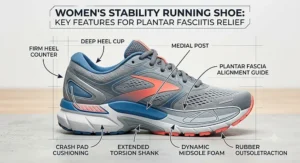
The good news is that 2026’s shoe lineup is genuinely better than it was even two years ago. Brands have quietly moved away from the stiff plastic medial posts that used to define “stability,” replacing them with softer, smarter guidance systems that correct your stride without punishing your arch for existing. That shift matters enormously if your plantar fascia is already inflamed and irritable.
This guide walks through seven real, currently available shoes — tested, reviewed, and picked apart by podiatrists, run-shop staff, and everyday women who’ve actually lived in them. We’ll cover who each shoe is for, what the spec sheet doesn’t tell you, and how to match a shoe to your specific foot instead of chasing whatever’s trending on social media. The plantar fascia itself is a fibrous band of tissue running along the bottom of the foot, connecting heel to toes and acting as a natural shock absorber with every step — which is exactly why footwear choice has an outsized effect on how fast, or whether, you heal. For more on the condition itself, Mayo Clinic’s overview of plantar fasciitis is a solid starting point before you shop.
Before we get to the individual shoes, here’s the shortcut version for anyone who wants the verdict without the deep dive.
Quick Comparison Table
| Shoe | Best For | Price Range | Stability System |
|---|---|---|---|
| Brooks Adrenaline GTS 25 | Best overall stability leader | $140-$150 | GuideRails |
| ASICS Gel-Kayano 32 | Severe overpronation, max cushion | $160-$175 | 4D Guidance System |
| Hoka Arahi 8 | Lightweight daily stability | $140-$150 | H-Frame |
| New Balance Fresh Foam X 860v14 | Narrow feet, multiple widths | $140-$150 | Dual-density midsole |
| Saucony Guide 19 | Budget-conscious runners | $140-$150 | CenterPath |
| Brooks Glycerin GTS 23 | Max cushion, all-day wear | $165-$175 | GuideRails + DNA Tuned |
| New Balance Fresh Foam X More v5 | Orthotic and insert compatibility | $150-$165 | Wide dual-density platform |
Looking at the table, you’ll notice something interesting: the priciest shoe isn’t automatically the “best” one. The Saucony Guide 19 sits at the bottom of the price range but earns its spot through genuinely competent, subtle stability — proof that the correction technology matters more than the number on the tag. Meanwhile, the ASICS Gel-Kayano 32 and Brooks Glycerin GTS 23 justify their higher price with more aggressive cushioning stacks, which matters if your plantar fasciitis is severe enough that every footstrike needs extra shock absorption. If you’re newer to stability shoes or just want to test the category before committing, the Hoka Arahi 8 and New Balance Fresh Foam X 860v14 land in a comfortable middle ground of price and support.
💬 Bookmark this table — you’ll want to reference it again once you’ve read the full breakdown below.
Top 7 Stability Running Shoes for Women With Plantar Fasciitis: Expert Analysis
Every shoe below was chosen because it’s a real, currently sold model with verifiable specs and a track record of actual customer and expert reviews — not a listing dressed up to look impressive. We looked for genuine motion-control engineering, cushioning that protects the heel strike, and upper construction that won’t aggravate an already-cranky plantar fascia.
1. Brooks Adrenaline GTS 25 — the stability all-rounder for flat feet
The Adrenaline has been the default recommendation for overpronators for years, and the GTS 25 doesn’t mess with a winning formula so much as sharpen it. Its GuideRails support system doesn’t grab your foot and force it into a “correct” position; instead it only engages when your knee or ankle drifts outside its natural path, which is a meaningfully gentler approach for anyone already dealing with inflamed tissue. Based on the spec comparison, the DNA Loft v3 midsole is noticeably softer than prior Adrenaline generations, which matters because a firmer landing surface transmits more shock straight into an already-irritated plantar fascia.
Podiatrist commentary consistently points to this model for flat-footed runners with plantar fasciitis specifically because it manages excess motion without feeling like a cast around your foot. Reviewers consistently report a lighter, smoother ride in this version compared to older Adrenaline models, alongside praise for the updated, roomier fit through the midfoot. What most buyers overlook is that the shoe’s stability comes from geometry and foam density rather than a rigid plastic post — that’s precisely why it doesn’t feel punishing on morning runs when your heel is at its most sensitive.
Pros:
- ✅ GuideRails correct motion without locking the foot rigidly in place
- ✅ Softer DNA Loft v3 cushioning reduces strain on the plantar fascia
- ✅ Reliable, true-to-size fit trusted across many Adrenaline generations
Cons:
- ❌ Less exciting underfoot feel than bouncier neutral trainers
- ❌ Narrower toe box than max-cushion competitors like the Brooks Glycerin GTS 23
Expect to pay around $140-$150 for the Adrenaline GTS 25, and given how consistently it shows up on podiatrist recommendation lists, it’s one of the safest first purchases if you’re new to stability shoes altogether.
2. ASICS Gel-Kayano 32 — the max-cushion tank for severe overpronation
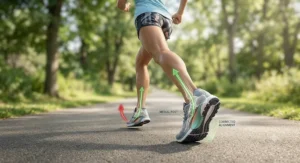
If your overpronation is moderate to severe, not mild, the Kayano is built specifically for you. Here’s what the spec sheet won’t tell you outright: ASICS dropped the heel-to-toe offset to 8mm in this generation — the lowest a Kayano has ever gone — which shifts a bit of load toward the midfoot and forefoot instead of dumping it all on the heel with every strike. That’s a meaningful design decision for plantar fasciitis sufferers, since concentrated heel impact is exactly what keeps the fascia inflamed.
On paper, the 4D Guidance System combines sidewalls, a guidance tab under the arch, and a flared forefoot to keep your foot centered without an old-school medial post. Testers describe the ride as stable but firm, with the shoe favoring shock absorption and control over bounce or energy return. That tradeoff is intentional: this is a shoe engineered for heavier runners with light-to-severe pronation who need a supportive, comfort-driven ride, not a race-day flyer. Aggregated review sentiment repeatedly flags the shoe’s weight and bottom-heavy feel as its main drawback, so if you’re a lighter runner with only mild pronation, this may be more shoe than you need — the Brooks Adrenaline GTS 25 would likely serve you better.
Pros:
- ✅ Lowered 8mm drop reduces concentrated pressure on the heel
- ✅ 4D Guidance System adapts to fatigue late in long runs
- ✅ Exceptionally durable outsole built for high weekly mileage
Cons:
- ❌ Noticeably heavier than lighter stability alternatives
- ❌ Firmer foam delivers lower energy return than premium price suggests
The Gel-Kayano 32 typically runs $160-$175, though check current price closely — ASICS’ newer Kayano 33 has already begun rolling out, which means retailers are actively discounting remaining Kayano 32 stock.
3. Hoka Arahi 8 — the lightweight, APMA-approved daily stability shoe
The Arahi occupies a strange, useful niche: it delivers genuine motion control while weighing noticeably less than most stability shoes in its class. Hoka’s proprietary H-Frame design wraps structural support around the heel and midfoot rather than relying on a dense foam wedge, which is why the shoe manages to feel more agile underfoot than its stability-shoe peers. Reviewers who’ve worn the Arahi line for years and manage their own plantar fasciitis specifically credit its ability to mitigate overpronation as the reason they keep repurchasing it.
Here’s what most people miss: the H-Frame’s corrective structure isn’t just about controlling your ankle roll — it also reduces the compensatory overcorrection from other lower-leg muscles, which indirectly spares the plantar fascia from extra strain during long runs or marathon training blocks. The shoe also carries the American Podiatric Medical Association’s Seal of Acceptance, a credential that only goes to footwear meeting specific foot-health criteria — worth knowing if you want your shoe choice backed by more than marketing copy. You can browse the full criteria behind the APMA Seal if you want to verify which models currently carry it.
Pros:
- ✅ Noticeably lighter than most stability shoes in its category
- ✅ H-Frame design corrects overpronation without excess muscle overcorrection
- ✅ APMA Seal of Acceptance for foot-health promotion
Cons:
- ❌ Firmer ride than max-cushion options like the ASICS Gel-Kayano 32
- ❌ Narrower fit through the forefoot than some testers expect
Price sits around $140-$150. Note that Hoka’s next iteration, the Arahi 9, is expected to arrive shortly, which may push retailers to discount remaining Arahi 8 inventory in the coming months.
4. New Balance Fresh Foam X 860v14 — best for narrow feet and multiple widths
Most stability shoes offer standard and maybe wide. The 860v14 offers narrow, standard, wide, and extra wide — a genuinely rare spread that solves a real problem for women whose feet don’t fit the “average” last that most brands design around. Reviewers with narrow heels specifically note that this model holds an orthotic or insert in place better than New Balance’s wider stability options, which is a meaningful detail if you’re managing plantar fasciitis with a custom footbed alongside your shoes.
Based on the spec comparison, the shoe’s structured midsole and outsole are designed to correct overpronation directly, which is what eases the repetitive strain pulling on your plantar fascia with every stride. What buyers overlook is that this correction happens through the midsole geometry itself rather than an aggressive medial post, meaning the shoe stays comfortable enough for genuine all-day wear — not just short runs. That versatility explains why it turns up so often on “best for orthotics” roundups aimed specifically at women.
Pros:
- ✅ Four width options accommodate narrow to extra-wide feet
- ✅ Midsole and outsole structure actively corrects overpronation
- ✅ Lightweight build makes it comfortable for extended daily wear
Cons:
- ❌ Elasticized tongue creates a tighter fit some reviewers find restrictive
- ❌ Less plush cushioning than the Brooks Glycerin GTS 23
Expect a price in the $140-$150 range — solidly mid-pack for a shoe with this much width flexibility.
5. Saucony Guide 19 — the budget-friendly, no-medial-post stability shoe
The Guide 19 represents what Saucony calls the “Stability Renaissance” — brands ditching the hard plastic medial post in favor of structural cues that guide your stride without feeling like a 2×4 strapped to your arch. Its CenterPath technology relies on a broad base, high sidewalls, and a subtly asymmetrical last that nudges your foot away from pronation, rather than physically blocking the motion. Here’s what that means in practice: you get real, felt stability, but nothing about the ride feels corrective or intrusive — a distinction that matters enormously if plantar fasciitis has made you sensitive to shoes that feel like they’re fighting your foot.
Reviewers dealing with overpronation and plantar fasciitis specifically call out the Guide 19 for delivering legitimate support without the premium price tag of the Kayano or Glycerin lines. The updated PWRRUN foam softens the ride slightly compared to previous Guide generations, and the new engineered mesh upper adds a more structured, secure step-in feel with almost no break-in period required — a real plus if morning heel pain means you want zero friction between putting the shoe on and getting out the door.
Pros:
- ✅ Genuine stability without a rigid, old-fashioned medial post
- ✅ Softer PWRRUN foam than earlier Guide generations
- ✅ Best-in-class value among true stability daily trainers
Cons:
- ❌ Subtle stability may feel insufficient for severe overpronators
- ❌ Not the most exciting or lively ride for faster-paced runs
At around $140-$150, this is the shoe to start with if you’re testing whether stability shoes even help your plantar fasciitis before spending premium money.
6. Brooks Glycerin GTS 23 — max cushion stability for all-day, every-day wear
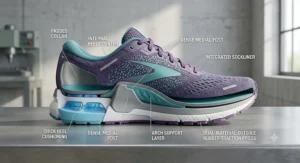
Think of the Glycerin GTS as the Adrenaline’s plusher, more indulgent sibling. It carries both the APMA Seal of Acceptance and PDAC A5500 diabetic-shoe certification, two credentials that signal serious attention to foot-health engineering rather than marketing fluff. The GuideRails Holistic Support System here is tuned for mild-to-moderate support — it gently corrects excess motion but stays out of the way when your stride doesn’t need intervention, which is precisely the kind of “invisible” correction that plantar fasciitis sufferers tend to tolerate best over long mileage.
What most buyers overlook is the added 2mm of nitrogen-infused DNA Tuned cushioning in the forefoot this generation, engineered specifically to soften landings while still energizing toe-off. Real customer reviews consistently mention pain relief within hours to days of switching to this model for plantar fasciitis specifically, alongside praise for how well it doubles as an all-day healthcare-shift or standing-job shoe, not just a running shoe. The tradeoff for all that plush structure is weight and a firmer-than-expected midsole underfoot, plus a toe box that some reviewers feel runs a touch snug even after sizing up.
Pros:
- ✅ APMA Seal and PDAC diabetic-shoe certification signal genuine foot-health engineering
- ✅ Extra forefoot cushioning specifically targets softer landings
- ✅ Doubles effectively as an all-day standing or walking shoe
Cons:
- ❌ Heavier than most shoes in this comparison
- ❌ Some reviewers find the toe box runs tight
Pricing typically falls in the $165-$175 range, making it one of the pricier picks here — though for all-day wear on top of running, many reviewers consider it worth the premium.
7. New Balance Fresh Foam X More v5 — best for orthotic and insert compatibility
If you’re managing plantar fasciitis with a custom orthotic, this is the shoe built around that reality rather than working against it. The More v5 delivers a plush 35mm heel stack on a 4mm drop, and critically, its removable insole sits on a perfectly flat bed — meaning your custom footbed sits flush instead of getting lifted or tilted the way it can in shoes with contoured stock insoles. On paper this means less guesswork when you’re trying to combine an aftermarket arch support with a running shoe’s own stability features.
Here’s what the spec sheet won’t spell out: the wide base platform compensates for the shoe’s exceptionally soft Fresh Foam X compound, which prevents the wobbly, unstable sensation that often plagues other max-cushion trainers when you add bulk from an orthotic. What most orthotic users overlook is that a generous toe box matters just as much as insole depth — cram an orthotic into a narrow forefoot and you’ll create new pressure points even as you solve the arch-support problem. The More v5 solves both halves of that equation simultaneously.
Pros:
- ✅ Flat, removable insole bed keeps custom orthotics properly seated
- ✅ Wide platform prevents wobble despite very soft cushioning
- ✅ Generous toe box accommodates orthotics without new pressure points
Cons:
- ❌ Soft ride may feel less “locked in” than firmer stability options
- ❌ Premium pricing compared to non-orthotic-focused alternatives
Expect to pay around $150-$165 — a fair ask given how few running shoes are genuinely engineered around orthotic compatibility rather than treating it as an afterthought.
What Is Plantar Fasciitis?
Plantar fasciitis is inflammation of the plantar fascia, the thick band of tissue connecting your heel to your toes that supports your arch and absorbs shock with every step. It typically causes stabbing heel pain that’s worst with your first steps in the morning, easing somewhat with movement, then flaring again after long periods of standing or sitting.
The condition is common, frustrating, and — the genuinely good news — highly treatable. Telltale signs typically include sharp heel pain with your very first steps in the morning, a return of that pain after standing up from sitting, and discomfort that builds after long stretches on your feet. Left untreated, it can trigger compensatory knee, hip, and back pain as you unconsciously alter your gait to avoid the discomfort — which is exactly why footwear that addresses the underlying mechanics, not just cushioning, matters so much.
How to Choose Stability Running Shoes for Women With Plantar Fasciitis
Shopping by brand loyalty or Instagram ads is how a lot of women end up with shoes that look great and do nothing for their heel pain. Here’s a more reliable process:
- Get your gait assessed first. A run-specialty store or podiatrist can tell you whether you overpronate mildly, moderately, or severely — that single data point determines whether you need a subtle shoe like the Saucony Guide 19 or a heavy-duty one like the ASICS Gel-Kayano 32.
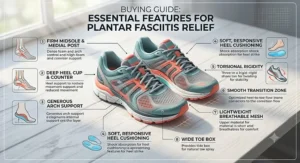
- Prioritize a deep heel cup. A reinforced heel counter keeps your natural fat pad centered under the heel bone, which directly reduces the jarring impact that aggravates the plantar fascia.
- Look for a higher heel-to-toe drop. Shoes in the 8mm to 12mm range shift some mechanical pull off the back of the heel, easing tension on already-inflamed tissue.
- Consider forefoot rigidity or a rocker sole. A shoe that resists bending too easily at the toes lets your foot roll through the stride instead of stretching the arch painfully with every step.
- Match cushioning to your body weight and mileage. Heavier runners and higher weekly mileage both call for denser, more protective foam — think the Brooks Glycerin GTS 23 — while lighter, lower-mileage runners can often get away with something like the Hoka Arahi 8.
- Check width options if you have a narrow or wide foot. The New Balance Fresh Foam X 860v14 is the standout here, with four distinct width choices.
- Don’t over-correct. If you only mildly overpronate, an aggressively structured shoe can actually create new compensation issues in your hips and ankles — match the correction to your actual severity, not the most “supportive-looking” shoe on the shelf.
Stability Shoes for Women With Heel Pain: What Actually Helps
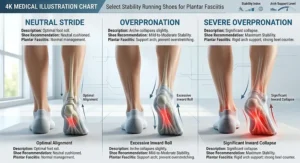
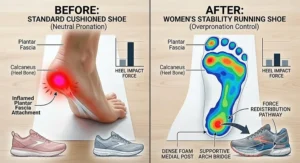
Not every case of heel pain responds to the same fix, and “stability shoe” isn’t a magic phrase that solves all of them. Stability shoes for women with heel pain work by reducing excess pronation — the inward roll of your foot after it strikes the ground — because that repetitive inward collapse is what keeps tugging on an already-irritated plantar fascia with every stride.
What most buyers overlook is that stability isn’t just about a rigid arch or a hard wedge under your foot. Modern systems like Brooks’ GuideRails or ASICS’ 4D Guidance work more like guardrails on a highway: they let your foot move naturally most of the time and only intervene when your motion starts drifting toward a pattern that would strain your fascia further. That’s a meaningfully different philosophy than the stiff, corrective shoes of a decade ago, and it’s a big part of why today’s stability shoes are more tolerable for sensitive, already-inflamed feet.
If your heel pain is specifically worse on one side, or you notice your shoe wearing unevenly on the inside edge, that’s a strong signal you’re dealing with pronation-driven heel pain rather than a purely cushioning problem — and a genuine stability shoe, not just a soft one, is the more appropriate fix.
Arch Support Running Shoes: Why More Isn’t Always Better for Women in Pain
There’s a persistent myth that the firmest, most aggressive arch support running shoes women can buy are automatically the best choice for pain. In reality, over-correction is a real and common problem. If you only mildly overpronate, a shoe with an intense medial post or an ultra-rigid arch shelf can force your foot into an unnatural position, which sometimes shifts strain to your ankles, knees, or hips instead of actually resolving it.
Based on the spec comparison across this list, the shoes that tend to earn the most consistent praise from people specifically managing plantar fasciitis — the Saucony Guide 19, the Brooks Adrenaline GTS 25 — use moderate, adaptive support rather than maximum rigidity. The takeaway: match your arch support to your actual pronation severity, confirmed by a gait assessment, rather than assuming “more support” is always the safer bet. Reviewers who describe a shoe as feeling like “a 2×4 strapped to your arch” are almost always describing an over-corrective shoe mismatched to a milder need.
Orthotic-Friendly Upper Design: What to Look For
If you already use a custom or over-the-counter orthotic, the shoe’s upper and internal volume matter just as much as its outsole stability. An orthotic-friendly upper needs a few specific features: a removable stock insole (never glued in place), a flat internal insole bed rather than a heavily contoured one, a roomy midfoot cage that won’t squeeze the orthotic out of alignment, and a secure heel counter that keeps everything from slipping during a run.
What most people overlook is the lacing structure. The heel-lock or “runner’s loop” lacing technique becomes essential once you add an orthotic, since the extra volume changes how the collar sits against your ankle — without that adjustment, plenty of otherwise-good shoes will feel sloppy or slip at the heel. The New Balance Fresh Foam X More v5 stands out here specifically because of its flat insole bed and generous toe box, but the same principles apply if you’re evaluating any shoe on this list against your existing orthotic.
Stability Running Shoes vs Neutral Running Shoes for Plantar Fasciitis
| Factor | Stability Shoes | Neutral Shoes |
|---|---|---|
| Best For | Overpronators, flat feet, moderate-severe plantar fasciitis | Neutral gait, high arches, mild heel pain |
| Correction | Active guidance (GuideRails, 4D Guidance, H-Frame) | None — relies purely on cushioning |
| Common Pick | Brooks Adrenaline GTS 25, ASICS Gel-Kayano 32 | Max-cushion neutral models like Hoka Bondi |
| Risk If Mismatched | Over-correction, hip/ankle compensation | Continued overpronation, unresolved strain |
This comparison isn’t really a contest — it’s a matching exercise. A neutral shoe with plush cushioning genuinely works well for someone whose plantar fasciitis stems from localized heel impact rather than pronation, particularly if they have naturally high arches. But if your gait assessment shows any degree of overpronation, a neutral shoe will let that inward roll continue unchecked, which typically means your plantar fasciitis symptoms plateau instead of improving no matter how cushioned the shoe feels underfoot. The clearest signal: check your old running shoes for uneven wear on the inner edge of the sole — that’s the tell that stability, not just cushioning, is what your feet actually need.
💬 Not sure which category fits you? A five-minute gait check at any run-specialty store will settle it for free.
Morning Heel Pain and Your Plantar Fascia Stretch Routine
Why Morning Heel Pain Happens
The reason that first step out of bed feels like stepping on a tack has a straightforward explanation: overnight, your plantar fascia contracts and tightens while your foot is at rest. The instant you put weight on it, that shortened tissue gets stretched abruptly, causing the sharp morning heel pain that’s practically a diagnostic hallmark of plantar fasciitis. This discomfort is typically at its worst first thing in the morning, and it typically improves somewhat as you move around and the tissue warms up and lengthens again.
5-Minute Plantar Fascia Stretch Routine
The single most effective habit you can pair with any shoe on this list is a consistent plantar fascia stretch routine, done before your feet even touch the floor. Research comparing stretching protocols found that a gastrocnemius-soleus calf-stretching program was significantly more effective at reducing plantar fasciitis symptoms than standard Achilles stretches alone, according to a randomized clinical study published via the National Center for Biotechnology Information. In practice, that means calf flexibility deserves just as much attention as the arch itself.
Try this sequence, ideally two to four times daily:
- Towel stretch (30 seconds, 2-3 reps): While seated with your leg out straight, loop a towel around your forefoot and gently pull toward you, keeping the knee straight.
- Wall calf stretch (45 seconds, 2-3 reps): Hands on a wall, affected foot back with a straight knee, front knee bent — shift forward until you feel the calf lengthen.
- Frozen bottle roll (2 minutes): Roll your arch over a frozen water bottle or a golf ball to combine a stretch with light massage and mild cold therapy.
Pairing this routine with a genuinely supportive shoe — rather than relying on either one alone — is consistently what produces faster, more durable relief.
Practical Usage Guide: Breaking In Your New Stability Shoes
New stability shoes don’t automatically fix plantar fasciitis the moment you lace them up — how you introduce them matters. Start with shorter runs, roughly half your normal distance, for the first one to two weeks. Your foot muscles and connective tissue need time to adapt to a new guidance pattern, even a beneficial one, and jumping straight into full mileage is a common way people end up sore in new places.
Check your lacing technique early. A heel-lock or runner’s loop keeps your foot from sliding forward inside the shoe, which matters enormously for stability shoes since forward slide undermines the entire guidance system built into the midsole. Rotate between two pairs if you’re running frequently — giving foam 24 to 48 hours to fully decompress between runs meaningfully extends its supportive lifespan, which is a detail most shoe boxes never mention. Finally, watch your outsole wear pattern after the first month: uneven wear on the inner edge signals you may need a slightly more corrective model, while flat, even wear suggests your current shoe is matched well to your gait.
Common first-30-day mistakes worth avoiding: skipping the break-in mileage ramp, ignoring persistent hot spots instead of adjusting laces, and continuing high mileage through morning heel pain instead of addressing it with the stretch routine above.
Real-World Scenarios: Which Shoe Fits Your Life
The busy nurse on 12-hour shifts: If you’re on concrete floors most of your waking hours and only run a few miles a few times a week, all-day comfort matters more than race-day performance. The Brooks Glycerin GTS 23 — with its APMA and PDAC certifications built around foot-health rather than speed — is designed almost exactly for this situation.
The budget-conscious beginner testing stability shoes for the first time: If you’re not even sure stability shoes will help yet, sinking $170 into a max-cushion model before you know your own gait pattern doesn’t make sense. The Saucony Guide 19 offers legitimate motion control at the lowest price point here, making it the lower-risk way to test the category.
The marathon trainer with narrow feet and an orthotic: High weekly mileage combined with a narrow foot and a custom insert is a genuinely tricky combination to shop for. The New Balance Fresh Foam X 860v14 or the New Balance Fresh Foam X More v5 both solve different halves of that puzzle — the 860v14 for a snugger, narrower fit, the More v5 for maximum orthotic compatibility and volume.
Common Mistakes Women Make When Buying Stability Running Shoes
The most frequent mistake is skipping a gait assessment entirely and guessing at pronation severity based on how flat your feet look standing still — static foot shape and dynamic running gait aren’t the same thing, and plenty of women with visually flat feet actually pronate only mildly once they’re moving. A close second is chasing the newest, most hyped model instead of the one that matches your specific severity; the ASICS Gel-Kayano 32 is a fantastic shoe, but it’s overkill — and arguably counterproductive — for someone with only mild pronation.
Another common misstep is buying based on outdated shoe-size assumptions rather than trying shoes on later in the day, when feet are naturally slightly swollen — the same swelling pattern that happens during a run. Finally, plenty of women replace their shoes far too infrequently; midsole cushioning breaks down well before the outsole visibly wears out, and running in dead foam re-exposes an already-recovering plantar fascia to impact it was never designed to absorb long-term.
Long-Term Cost & Maintenance
A $150 pair of stability shoes sounds steep next to a $40 fashion sneaker, but the real comparison is cost-per-mile, not sticker price. Most quality stability shoes last 300 to 500 miles before their midsole cushioning meaningfully degrades — at 300 miles, a $150 shoe works out to roughly $0.50 per mile, which is genuinely cheap insurance against a medical condition that can otherwise require physical therapy, orthotics, or worse.
Rotating two pairs — even two of the same model — extends usable lifespan because compressed foam needs recovery time between runs to fully rebound. Budget-focused runners can stretch value further by watching for the predictable price drops that follow a new model’s release: when the ASICS Gel-Kayano 33 rolled out, retailers immediately began discounting remaining Gel-Kayano 32 stock, and the same pattern repeats industry-wide every year. Maintenance itself is minimal — rinse mud off with cool water and air-dry away from direct heat, which warps midsole foam and shortens its supportive lifespan.
Features That Actually Matter (And Those That Don’t)
Marketing copy loves to spotlight flashy details that don’t move the needle for plantar fasciitis specifically. Here’s the honest filter.
Actually matters: heel-to-toe drop (8-12mm reduces heel strain), a reinforced heel counter, genuine guidance-based stability technology, and a removable insole if you use orthotics. These four factors directly affect how much stress reaches your inflamed plantar fascia with every step.
Doesn’t matter much: trendy colorways, “carbon plate” marketing language borrowed from racing shoes (largely irrelevant to a daily stability trainer), and headline weight numbers in isolation — a slightly heavier shoe with excellent cushioning, like the Brooks Glycerin GTS 23, can outperform a lighter shoe with less protective foam for anyone actively managing heel pain. What most buyers overlook is that stack height numbers alone say little without knowing the foam’s actual density and compression-set rating, details that rarely appear on the product page but show up consistently in independent lab testing and long-term reviewer feedback.
Safety, Regulations & Podiatric Guidance
Look for the APMA Seal of Acceptance when you’re comparing shoes, since it signals the manufacturer submitted the product for review against specific foot-health criteria rather than simply claiming “podiatrist approved” in ad copy. Both the Hoka Arahi 8 and Brooks Glycerin GTS 23 on this list carry it. If your plantar fasciitis is severe, persistent beyond a few weeks of self-care, or paired with numbness or swelling, that’s a signal to involve a professional rather than shoe-shopping your way through it alone — supportive footwear is a genuinely effective piece of the puzzle, but it isn’t a substitute for a podiatrist’s evaluation when symptoms are significant. The American Academy of Orthopaedic Surgeons’ patient guide to plantar fasciitis and heel spurs is a useful, medically vetted resource if you want to understand when self-care is appropriate versus when it’s time to see someone in person.
✨ Ready to stop limping through your morning routine? Check current pricing on any pick above before your size sells out.
FAQ
❓ Do stability shoes actually help plantar fasciitis?
❓ How do I know if I overpronate?
❓ What heel-to-toe drop is best for plantar fasciitis?
❓ How often should I replace stability running shoes?
❓ Can I use orthotics with stability running shoes?
Conclusion
Plantar fasciitis doesn’t respond to guesswork, and neither should your shoe shopping. Whether you land on the reliably corrective Brooks Adrenaline GTS 25, the max-cushion ASICS Gel-Kayano 32 for more severe pronation, or the budget-smart Saucony Guide 19 while you’re still figuring out what your feet actually need, the throughline across every pick here is the same: real guidance technology, honest cushioning, and construction that respects an already-sensitive foot rather than fighting it.
Pair whichever shoe you choose with a consistent plantar fascia stretch routine, don’t skip the gait assessment, and give your feet the patience of a proper break-in period instead of jumping straight into full mileage. None of this requires perfection — it just requires matching the shoe to your actual foot instead of chasing whatever’s most hyped this season.
Recommended for You
- Stability running shoes women overpronation: 7 Top 2026 Picks That Actually Help
- Stability Running Shoes for Women: 7 Top Picks for 2026
- Neutral Running Shoes Women Under $130: 7 Picks for 2026
Disclaimer: This article contains affiliate links. As an Amazon Associate, I earn from qualifying purchases. If you purchase products through these links, we may earn a small commission at no additional cost to you.
✨ Found this helpful? Share it with a friend who’s been limping through her mornings too! 💬🤗
